

A shoe's stability label alone doesn't tell you whether it suits your walking pronation. For shoppers, construction and fit provide more useful comparisons than broad promises of support.
Cushioning, motion-control features, and shaped footbeds do different jobs, even when they appear in the same shoe. Start by understanding those differences, then compare how each pair feels on your feet.
Key Takeaways
- Cushioning and stability describe different shoe features; one doesn't automatically provide the other.
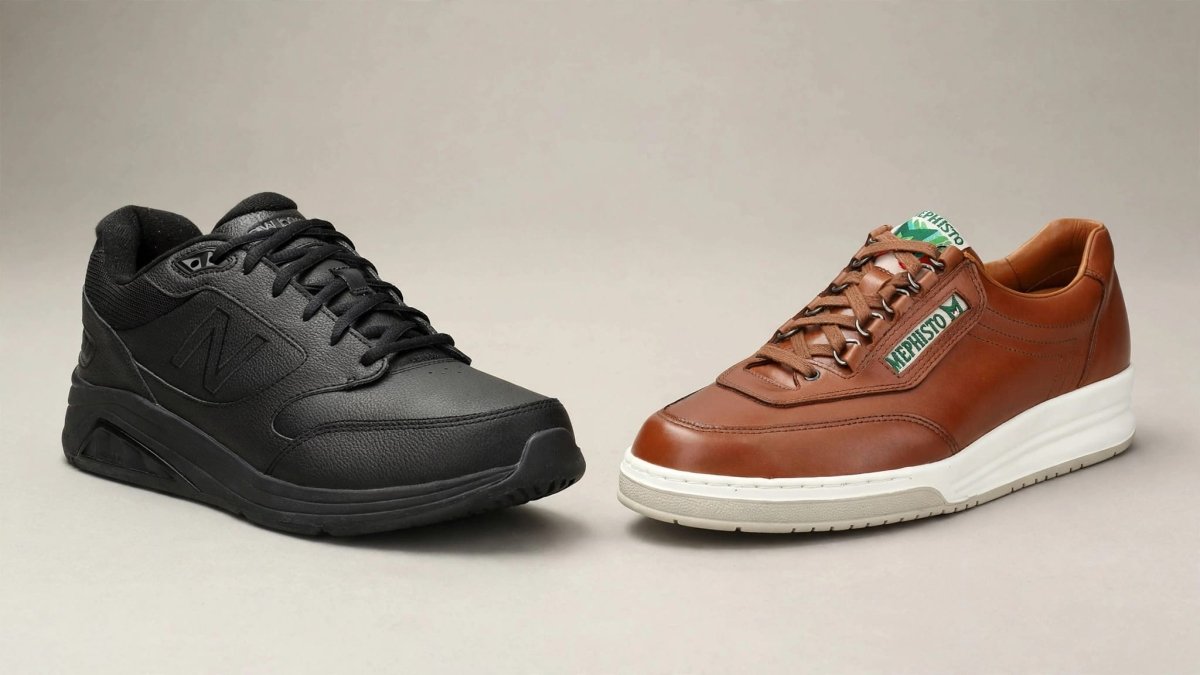
- New Balance MW928 models and Mephisto Match offer different combinations of structure, cushioning, and materials.
- Width, heel hold, toe room, and space for inserts matter alongside any support technology.
Walking Pronation and Shoe Support Labels
Support terminology can make two shoes sound interchangeable. However, a closer look at their construction reveals differences.
Stability Describes Structure
Stability features add structure to a shoe. Depending on the design, that structure might include a reinforced heel, a supportive midsole, or components that resist twisting.
New Balance uses names such as ROLLBAR and Walking Strike Path on its MW928BR3 walking shoe. These identify particular design features rather than a universal measure of support across brands. Compare the actual construction instead of assuming every shoe labeled "supportive" works alike.
Cushioning Describes Underfoot Comfort
Cushioning materials soften the feel underfoot. ABZORB, for example, is a named cushioning technology in the New Balance MW928 listings. Mephisto Match uses an Air-Bag shock-absorption feature.
A shoe can combine cushioning with substantial structure. However, softness alone doesn't establish how much structural support it offers.
A plush footbed tells you about cushioning, but it doesn't establish that a shoe has motion-control features.
Also consider where cushioning sits. Heel cushioning and full-length cushioning describe different arrangements, even when both shoes feel soft at first.
Walking Shoes With Features Worth Comparing
Our product descriptions identify several details you can use to compare walking shoes. Each feature answers a different shopping question.
New Balance MW928VK: ABZORB Cushioning
The New Balance MW928VK walking shoe is a men's black leather model with ABZORB cushioning. Its listed weight is 440.2 grams, or 15.4 ounces.
This gives you concrete information about its materials, cushioning, and weight. Consider those details together when comparing it with another pair. Weight is useful context, but the overall feel also depends on fit and how the shoe moves with your foot.
New Balance MW928BR3: Named Stability Technologies
The New Balance MW928BR3 walking shoe combines a brown leather upper with ROLLBAR and Walking Strike Path technologies. It also includes ABZORB SBS cushioning.
For shoppers comparing construction, this listing identifies both stability features and cushioning. Those are separate components within the same shoe. Because the black and brown options belong to the MW928 family, compare their listed details without assuming that a color difference means a different support category.
Mephisto Match: Leather and Adjustable Lacing
The Mephisto Match leather walking shoe features a full-grain leather upper, a latex foam rubber outsole, and Air-Bag shock absorption.
Speed lacing lets you adjust the fastening, while a padded tongue and collar cushion contact around the opening. These details are useful when comparing upper materials and closure design. They describe a different combination of features than the named motion-control technologies in the MW928BR3 listing.
Fit Matters Beyond the Support Label
Even an extensively structured shoe needs enough room for your foot. Start with both feet, since their dimensions can differ, and wear the socks you expect to use.
Allow roughly half an inch between your longest toe and the shoe's front. Your toes should spread without pressure along the sides. Meanwhile, the heel should feel secure without rubbing or requiring you to grip with your toes.
Walk at your usual pace and make several turns. Notice whether the upper presses across your forefoot, whether your heel lifts, and whether the shoe feels comfortable as you step.
Laces adjust hold, not shoe width. Tightening them cannot create more room across a cramped forefoot. Likewise, moving up a size may add length without solving a width mismatch.
You can compare pairs at our store at 155 West 72nd Street in New York City.
How Inserts Change the Fit Equation
An insert takes up space inside a shoe, so bring any insert you already wear when trying on footwear. A removable original footbed can allow a replacement insert to sit inside without stacking two full-length layers.
Insert designs also differ. Pedag Viva Sport uses a semi-rigid, heat-moldable footbed with longitudinal and metatarsal arch support and heel cushioning. Superfeet Blue includes a deep heel cup, a reinforced stabilizer cap, and full-length foam.
These are construction differences, rather than proof that one insert suits every shopper. After adding an insert, reassess toe room and heel hold because the available interior space has changed.
Frequently Asked Questions
Can I Choose Walking Shoes by Brand Alone?
Compare individual models rather than relying on a brand name. The listed materials, cushioning, fastening, and structural features give you a clearer basis for comparison. A familiar logo doesn't tell you how a particular shoe will fit.
Should Walking Shoes Feel Comfortable Immediately?
A new pair should feel comfortable during your initial walk. Don't accept pinching, rubbing, or toe pressure as a necessary break-in stage. Materials may soften with wear, but that doesn't make an uncomfortable size or shape a sound purchase.
Choose Features You Can Evaluate
When shopping with walking pronation in mind, keep product descriptions in perspective. Named technologies tell you about a shoe's construction; fit tells you how that construction feels on your feet.
Give comfortable fit priority alongside the features you want. A secure heel, adequate toe room, and suitable space for inserts make comparisons more useful than support labels alone.


