

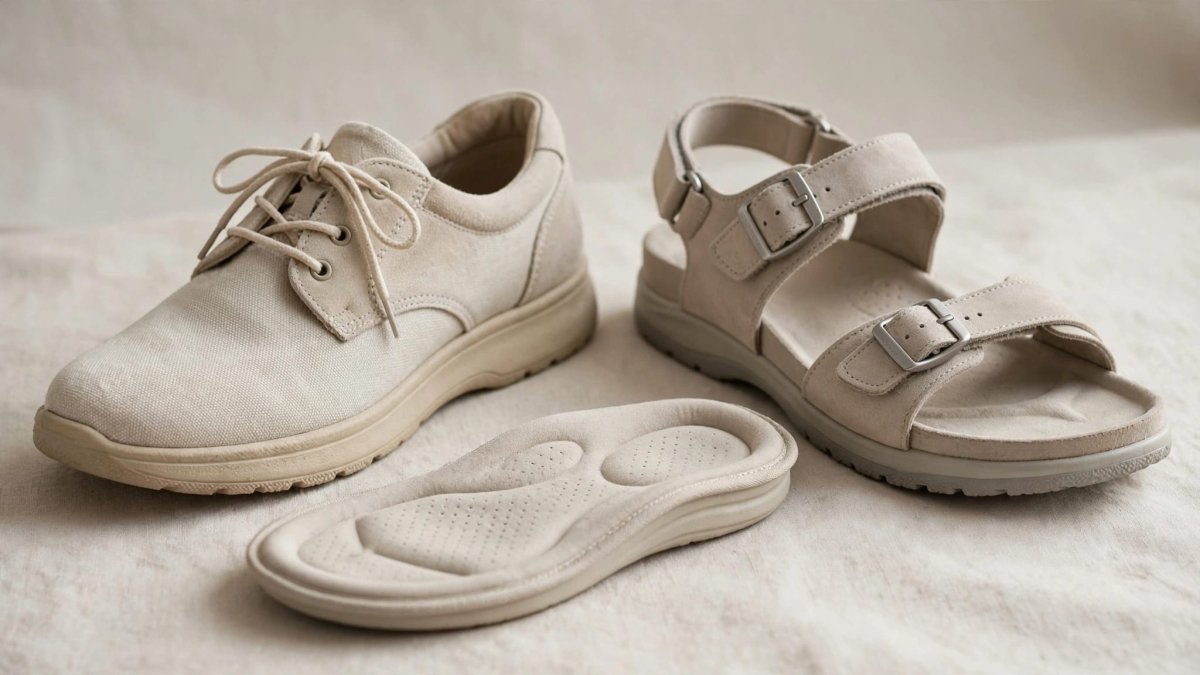
Swollen feet can make the same pair of shoes feel different as the day goes on. If a shoe feels comfortable in the morning but restrictive later, the details of its construction matter as much as its style.
Look at how the upper, closure, footbed and sole feel on your feet. Adjustability is one useful feature to compare, but it works differently in a laced shoe than in a sandal or clog.
Notice where the shoe feels different
A shoe wraps around several parts of your foot, and each area can feel different. You may notice pressure across the top, around the widest part of your foot or near your toes. A strap can also feel different from a seam, even when both sit in the same area.
The description of a shoe can help you narrow your choices, but it won't tell you exactly how the shoe will feel. A soft upper, for example, can have a firmer edge or stitching that you notice when you walk. Similarly, a cushioned footbed changes the surface under your foot, while the upper determines much of the feeling around it.
Pay attention to the details you notice in shoes you already own. If the pressure comes from a buckle, a different closure may interest you. If the top of the shoe feels restrictive, you may prefer comparing uppers with different shapes and materials.
Compare adjustable closures
Closures can change how a shoe feels across the top of the foot. Laces, buckles and hook-and-loop straps each offer a different way to adjust a shoe, so the most appealing option depends on where you notice pressure and how you use your shoes.
Laces offer several adjustment points
Laces run along the top of a shoe and can be adjusted along their length. That gives you more points to work with than a shoe that has a single strap. The tongue and the shape of the upper still affect how a laced shoe feels, though.
Our Mephisto Match black leather walking shoe has speed lacing for quick adjustment. It also has a padded tongue and collar. Those details make it a useful example to compare with a slip-on, although the feel remains personal.
Straps make adjustment easy to see
A buckle or hook-and-loop strap offers a visible adjustment point. Some shoes have one strap across the instep, while others have separate straps across different parts of the foot.
The position matters as much as the closure. A strap closer to the toes feels different from one near the ankle, and a broad strap distributes contact differently than a narrow one. Compare where each strap rests rather than choosing on appearance alone.
Understand width and shoe shape
Width is one part of a shoe's shape. Two styles with the same size label can feel different because their toe boxes, uppers and footbeds have different contours. A shoe described as wide may also feel different across the forefoot than across the top of the foot.
Look beyond the width label
Some shoes come in more than one width, while others use a single width. These labels are useful when comparing options within a style, but they don't describe every part of its shape.
If you have a pair that feels comfortable across the ball of your foot, notice its overall outline. A rounded front and a more tapered front create different spaces around the toes, even when the shoes carry the same size.
Consider depth across the top
The space between the footbed and upper can influence how a shoe feels over your instep. Laces or straps may change that feeling, but they don't change every part of the shoe's construction.
A padded tongue, a thick sock or an added insole can also alter the feel inside a closed shoe. When comparing pairs, notice which combination feels comfortable for your own foot.
Choose an upper that suits your preferences
The upper is the part of the shoe that covers or surrounds the foot. Leather, fabric and other materials can feel different against the skin, and the way they're assembled matters too.
A soft material doesn't mean the entire upper will feel soft. Stitching, linings and edges can create distinct areas of contact. Likewise, a structured upper may hold its shape more than a lightweight fabric upper. Neither construction guarantees comfort for every foot.
Consider how much coverage you want as well. A closed shoe surrounds more of the foot than an open sandal, while a clog leaves the back more exposed. Each style has a different feel when you move.
Your intended use matters here. A covered leather shoe may appeal for work or walking, while a sandal can be a practical choice for casual warm-weather wear. Comparing the feel of each style can be more useful than relying on the material name alone.
Compare walking shoes and clogs
Walking shoes and clogs give you different combinations of coverage, structure and support. Both can be everyday options, but they feel different underfoot and around the heel.
Walking shoes wrap around the foot
A lace-up walking shoe generally covers the top and sides of the foot. Its tongue, collar and laces all contribute to the feel. A padded collar may feel pleasant to one person, while someone else may prefer a less substantial edge around the ankle.
The sole also affects the experience. Some walking shoes feel flexible, while others have a firmer base. Consider the kind of surface you walk on and whether you prefer a softer or more structured feel.
Clogs have a distinct shape and motion
Our Dansko Professional leather clog has a roomy toe box, a contoured midsole and a rocker bottom. Its construction feels different from a laced walking shoe, particularly around the open back.
A rocker sole has a curved profile that changes how the shoe moves through a step. Some shoppers enjoy that motion, while others prefer a flatter-feeling sole. Try the style as a whole rather than judging it by one feature.
Explore the feel of adjustable sandals
Sandals leave more of the foot exposed than closed shoes, so the straps and footbed become especially noticeable. The width, placement and edges of the straps all contribute to how a pair feels.
The Birkenstock Arizona Birko-Flor sandal has two adjustable straps and a contoured footbed. Its listing includes regular and narrow width options. The straps and shaped footbed give it a different feel from a flat sandal or a closed walking shoe.
When comparing sandals, notice the footbed as well as the straps. A contoured surface has a different feel under the arch and heel than a flatter one. Some people like that defined shape; others prefer a less pronounced contour.
The sole matters too. A sandal intended for a short outing may feel different from one you plan to wear throughout a day of walking. Choose the type of construction that suits the occasion and your own preferences.
Consider cushioning and insoles separately
Cushioning and fit are related, but they describe different things. Cushioning changes the feel underfoot, while the upper and internal shape affect how the shoe surrounds your foot.
More cushioning changes the feel underfoot
A soft footbed can feel comfortable when you first put a shoe on. A firmer footbed offers a different sensation, particularly under the arch and heel. Neither feel is universally preferable.
The thickness of cushioning can matter inside a closed shoe. A thick sock or insert changes the combination you're wearing, so compare the shoe with the items you expect to use with it.
Inserts have their own shape
Some shoes have removable footbeds, while others have fixed ones. An insert can add cushioning or a different contour under the foot, depending on its design.
For example, our Superfeet Blue trim-to-fit insoles have a deep heel cup and full-length foam. They're a separate accessory rather than a feature of the shoes described above. The feel of an insert depends on both its shape and the shoe around it.
Compare shoes for the way you dress
The shoes you choose for a commute may differ from those you wear for an evening out or around the house. Looking at the whole outfit, including socks, makes comparisons more meaningful.
A thin dress sock feels different from a thick cushioned sock. Tights and bare feet also create different contact with the lining. The same shoe can therefore feel different depending on what you wear with it.
Closures can influence everyday convenience. Laces offer several adjustment points, while a buckle has a different process for putting the shoe on and taking it off. A backless clog offers another experience altogether.
Style preferences count as well. If you prefer a polished leather shoe, you can compare the shape and closure with those of a more casual pair. Comfort features appear in many styles, so there's room to consider how a shoe looks alongside how it feels.
Make comparisons that matter to you
Product descriptions are most useful when you connect them to your own preferences. Instead of treating every feature as equally important, focus on the details you notice when wearing shoes.
If you like changing the closure during the day, compare laces with straps. If you prefer a defined surface underfoot, look at contoured footbeds alongside flatter options. If the front of a shoe gets your attention first, compare its shape with that of a pair you enjoy wearing.
Reviews can add another perspective, but they're personal accounts. One shopper may describe a shoe as roomy, while another notices pressure in the same style. Foot shape, socks and preferences all influence those impressions.
You can also compare styles in person at our store at 155 West 72nd Street in New York City. Seeing a walking shoe, clog and sandal side by side makes their differences in construction easier to judge.
Finding a shoe that feels right
Swollen feet can change your experience of a familiar shoe. Comparing the closure, upper and footbed gives you a clearer picture of what you prefer.
Focus on the feel of the whole shoe, rather than a single feature or label. The right choice is the one that suits your foot and the way you plan to wear it.


