

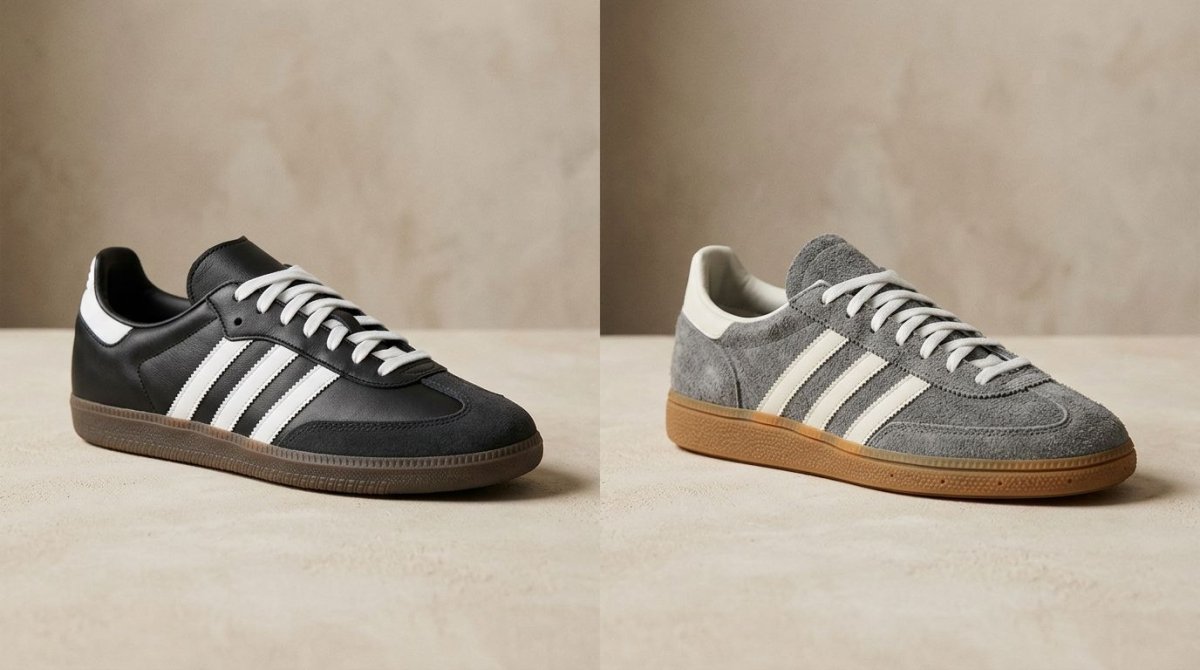
The Adidas Samba OG and Handball Spezial have different uppers and construction details, but their product descriptions don't establish that one fits wider or longer than the other. Your best choice depends on how the individual pair feels around your toes, instep and heel.
Both have a low-profile look and adjustable laces. If you're choosing between them, start with their materials, then compare their fit while standing and walking.
Samba vs Handball Spezial: Key Takeaways
The two shoes share Adidas' sports heritage, but the versions below use different materials.
| Feature | Samba OG Black/White | Handball Spezial Grey Strata |
|---|---|---|
| Upper | Smooth leather with a suede T-toe | Cow-suede upper |
| Closure | Laces | Laces |
| Outsole | Gum rubber | Gum rubber |
| Fit description | Comfortable fit | Regular fit |
The table compares two specific colorways. It doesn't provide measurements of their internal width, length or toe space.
Both shoes are candidates for everyday casual wear. When choosing between them, pay more attention to pressure and movement on your feet than to the fit label alone.
How the Two Adidas Shoes Are Built
The Samba OG and Handball Spezial have distinct looks that start with their uppers. Those materials also affect the surfaces you feel against your feet.
Samba OG: Leather with a suede T-toe
The Adidas Samba OG in black and white combines a smooth leather upper with a soft suede T-toe. The overlay runs across the front of the shoe, giving the Samba its recognizable toe design. A gum rubber outsole completes the look.
When trying it on, pay attention to the front of your foot as you bend your toes. The upper should feel comfortable across the joints behind your toes, including when the shoe flexes as you walk.
Leather can soften with wear, but don't rely on it to fix pressure at the toes or a shoe that's too short.
Handball Spezial: A suede upper
The men's Handball Spezial in Grey Strata has a cow-suede upper, lace closure and gum rubber outsole. Our listing describes that pair as a regular fit. The Handball Spezial was first introduced in 1979 as a court shoe.
Suede gives this version a different surface and feel from the smooth leather Samba. When you try it, notice how the upper sits over the ball of your foot and whether any seams or overlays create pressure.
A softer-feeling material can be appealing, but it doesn't establish how much room the shoe has inside.
What to Know About Sizing
Start with your usual Adidas size as a point of comparison. Then judge the pair on your feet, since a size label alone doesn't describe the shape of the toe area, internal depth or how securely your heel sits.
Product descriptions can use different language for individual versions. For example, our women's Samba OG in Wonder Quartz is described as a regular fit, as is the Grey Strata Handball Spezial. That wording is useful, but it doesn't establish that the two shoes have identical dimensions.
If you're comparing men's and women's listings, use the relevant Adidas size conversion as a starting point rather than assuming the same number means the same fit. Even after converting, try both shoes on and assess them while standing.
A half-size change affects overall fit, not only the area that feels tight. If going up gives your toes more room but leaves your heel slipping, compare the other model rather than accepting a loose heel.
Compare Toe Room and Forefoot Fit
Toe space is often the first detail shoppers notice, but length and width need separate attention. A shoe can have room in front of the longest toe and still press at the sides.
Check length while standing
Put on both shoes and stand with your weight evenly distributed. Your toes should lie naturally, with some space in front of the longest one. They shouldn't touch the front when you walk.
Try the shoes with the socks you expect to wear most often. A thicker sock takes up space inside, so a fit that works with thin socks may feel different with your everyday pair.
If one foot is longer, use that foot to judge the available space. Walk at your normal pace and notice whether your toes slide forward or touch the front as you step.
Notice pressure across the forefoot
The widest part of your foot should sit comfortably in the shoe without the sides squeezing your toes together. Look for pressure around the ball of the foot and at the base of the little toe.
The Samba's suede T-toe and the Spezial's suede upper create different exterior designs. Neither detail tells you which shoe will suit your forefoot without trying it.
If either pair pinches when new, compare another size or model. A shoe that leaves a pronounced pressure point is a poor fit to rely on for regular wear.
Adjust the Laces and Check Your Heel
A lace-up sneaker should hold your foot securely without needing to be pulled painfully tight. Both models let you adjust the laces, which can help you assess the fit across the top of your foot.
Make room over the instep
The instep is the raised area on top of your foot, between your toes and ankle. Loosen the laces before putting the shoes on, then tighten them gradually from the bottom upward.
You should feel contact across the top of the foot without a hard line of pressure. If the tongue or laces dig in, try a gentler adjustment. On the other hand, if the shoe only feels secure when the laces are pulled uncomfortably tight, the overall fit may not be right.
Walk to assess heel movement
Once the laces are adjusted, walk several steps and turn. Your heel should feel secure without rubbing against the collar or lifting excessively.
A little movement during a step can be normal, but repeated rubbing deserves attention. Compare both shoes under the same conditions: use the same socks, tie each pair comfortably and walk at the same pace. That makes it easier to notice a meaningful difference.
Consider Cushioning and Everyday Comfort
The Samba OG and Handball Spezial have a vintage sneaker profile. If you prefer a thick, soft running-shoe feel, pay attention to the cushioning underfoot before choosing either pair for long days.
The Handball Spezial in Night Indigo lists an OrthoLite sockliner. That feature belongs to the listed version, so it shouldn't be assumed for every Spezial colorway. It also doesn't establish that the shoe will feel more comfortable than a Samba on your feet.
Stand for a few minutes in each pair and notice the contact beneath your heel and the ball of your foot. Then walk on a firm indoor floor. A shoe can feel comfortable when you first put it on but less appealing once you start moving.
If you use an insert, bring it to the fitting. An insert takes up space, which can change the fit over your instep and around your toes. Don't assume either model has enough room for every insert.
How to Try Both Pairs On
A side-by-side comparison gives you more useful information than relying on another shopper's size recommendation. Feet differ in length, shape and sensitivity to pressure, even when the size number is the same.
Use the same starting conditions
Try both models with the same socks and at roughly the same time. Put each shoe on fully, with your heel settled at the back, before adjusting the laces.
Stand in both shoes rather than judging them only while seated. Your feet spread under your weight, so standing gives you a better sense of toe room and pressure across the forefoot. Assess both feet, since one may need more space than the other.
Test them in motion
Walk forward, turn and take a few natural strides. Pay attention to your toes, the flex point behind them and any rubbing at the heel. The shoe should feel secure without making you change your stride.
Our guide to testing shoe fit while standing and walking offers more detail on assessing each area. If you're trying shoes at home, use a clean indoor surface and keep the pair in the condition required for a return.
Allow for Break-In Without Accepting Pain
New leather and suede shoes can feel different after wear as their uppers soften and adapt. Give a comfortable pair some short indoor wear before making it your choice for a long day.
There's a difference between a shoe that feels new and one that causes pain. Persistent pinching, toes hitting the front or rubbing that worsens as you walk are reasons to reconsider the fit.
Also remember that materials won't add reliable length to a shoe. If your longest toe touches the front while standing or walking, choose a pair with more room rather than counting on break-in.
Suede and smooth leather also need different care. For either material, keeping the upper clean helps you maintain its appearance, but care products won't correct a poor fit.
Frequently Asked Questions
Should I buy the same size in both models?
Your usual Adidas size is a reasonable starting point for both. The product descriptions don't provide a direct size-by-size comparison, so assess each pair for toe space, pressure and heel hold.
Are these good shoes for long walks?
That depends on your feet and your cushioning preferences. Try each pair on a firm indoor floor and pay attention to how it feels underfoot. If you need substantial cushioning or use an insert, compare the fit with those needs in mind.
Which material should I choose?
Choose the smooth leather Samba if you prefer that finish and the suede T-toe design. The Grey Strata Handball Spezial offers a suede upper. In either case, let comfort take priority over the material.
Choose the Pair That Fits Your Feet
The Samba OG and Handball Spezial offer different materials and styling, but neither product description guarantees a better fit for you. Comfort in motion is the deciding factor.
Compare both pairs with your usual socks, give your toes room and walk before deciding. The right choice is the one that feels secure without pressure.


