

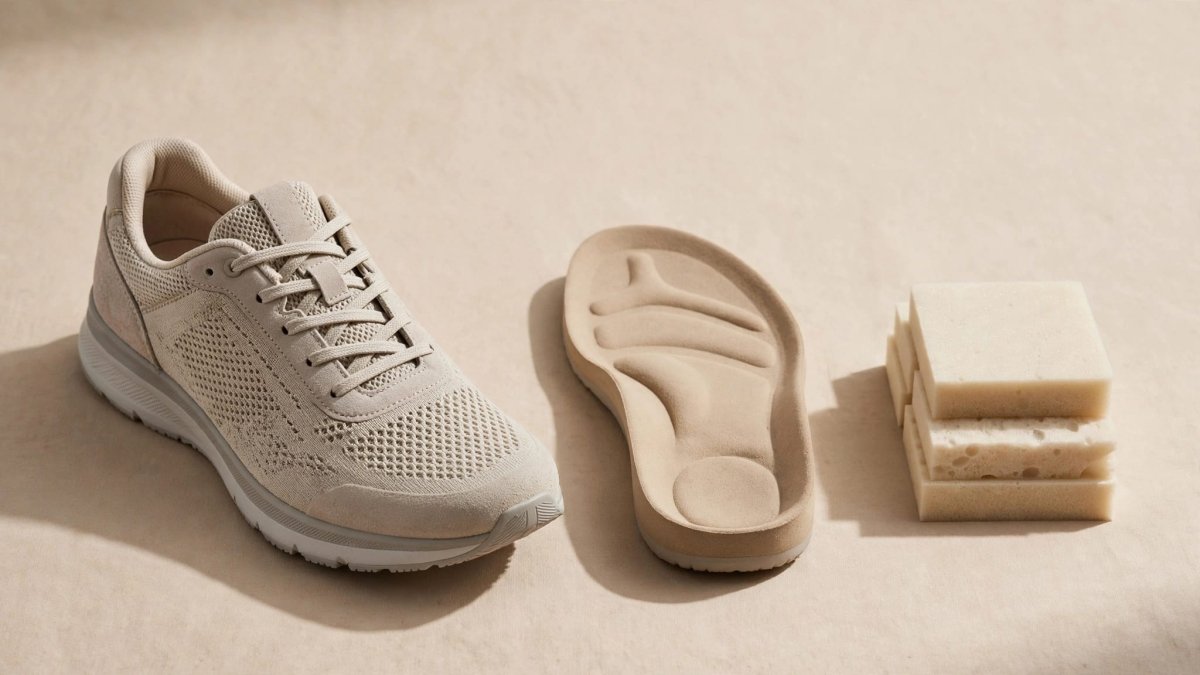
A shoe last isn't a complete comfort specification, so it shouldn't be your only guide when shopping. The footbed, cushioning, upper, and closure also deserve attention.
Product descriptions often group these features under words like "supportive" or "comfortable," although they describe different things. Start by separating construction details from broad comfort claims, then compare the features that matter to your everyday wear.
Key Takeaways
- Read footbed, cushioning, and closure details separately rather than treating "comfort" as one feature.
- Distinguish a shaped support component from soft foam; a product can include both.
- Treat customer reviews as individual experiences, especially when shoppers describe the same shoe differently.
Read Beyond the Shoe Last
When a product description mentions a shoe last, continue reading. That reference doesn't describe every component you'll encounter inside the finished shoe.
For example, a removable footbed, padded collar, and adjustable laces are separate product details. Each deserves its own place in your comparison.
Also, distinguish the shoe itself from an accessory sold separately. Our Birkenstock Blue Footbed is listed as a wide arch-support accessory for heeled footwear. Its product name describes that accessory, rather than the specifications of every Birkenstock shoe.
Precise descriptions make comparisons easier. "Removable cork-latex footbed" gives you more concrete information than "premium comfort," because it identifies both a component and its material.
Separate Support From Cushioning
Support and cushioning often appear together in product descriptions. However, the terms shouldn't replace information about the actual construction.
Look for Named Support Components
A support description becomes more useful when it names a physical feature. Examples include a semi-rigid arch structure, a shaped heel cup, or a stabilizer cap.
Pedag Men's and Women's Viva Full Insoles list semi-rigid longitudinal arch support. Superfeet Blue Trim to Fit lists a deep heel cup and reinforced stabilizer cap. These details describe identifiable components rather than a general promise of comfort.
The distinction matters when comparing accessories. Two products described as "supportive" can have different shapes, materials, and construction. Read those details individually instead of assuming the shared adjective means identical products.
Identify Where Cushioning Appears
Cushioning descriptions should tell you where the cushioning sits and what material provides it.
For example, Pedag Viva Full Insoles include a heel pad. Superfeet Blue Trim to Fit lists full-length foam and additional forefoot cushioning. Those descriptions identify different locations within the insole.
Similarly, a shoe's padded tongue and collar describe cushioning around the opening and closure area. They don't describe the underfoot component.
Keep these features separate during your comparison. Cushioning location is a more useful detail than an unsupported claim that a product feels soft everywhere.
Compare Footbeds by Their Construction
Footbed descriptions contain several useful distinctions. Length, materials, and removability tell you more than the word "anatomical" alone.
Full-Length and Shorter Designs
Pedag Viva Full and Viva Mini illustrate a clear construction difference: the Mini uses a three-quarter-length design, while the Full is a full-length insole.
That distinction describes how much of the shoe's interior the accessory covers. It doesn't establish that one design is universally better.
Profile is another separate detail. Superfeet Carbon Grey combines carbon fiber with lightweight foam and uses a thin construction. Meanwhile, Superfeet Blue lists a deep heel cup and full-length foam.
Compare the named features without turning them into a ranking. A longer feature list doesn't automatically make an accessory the right purchase for every shopper.
Materials and Removable Components
Material descriptions help identify what a footbed contains. Cork, latex, foam, and leather are different materials, even when listings use similar comfort language.
Also, distinguish a removable footbed from an accessory sold separately. A shoe listing that states "removable footbed" describes a component of that shoe. A standalone insole listing describes an additional product.
Read the complete phrase rather than stopping at "customizable" or "anatomical." For example, "removable cork-latex footbed" gives you two concrete details: its construction and its removability. Neither detail describes the shoe's upper, outsole, or closure.
Give Closures and Uppers Their Own Attention
An underfoot feature doesn't describe everything above it. Therefore, compare the upper and fastening system separately from the footbed.
A lace-up closure, zipper, and slip-on opening are distinct constructions. Product descriptions should identify which one the shoe uses. Padding around a tongue or collar is another detail worth separating from the closure itself.
Likewise, "leather upper" and "leather lining" describe different parts of a shoe. The upper forms the exterior above the sole, while the lining faces the foot.
Reading these terms carefully prevents a common shopping mistake: letting one appealing feature stand in for the entire product. A detailed footbed description leaves other components to assess.
FAQ
Is a Footbed the Same as an Insole?
Retailers sometimes use these terms interchangeably for an underfoot component. However, the product description should clarify whether it refers to an included shoe component or a separately sold accessory.
Look for concrete wording such as "removable," "full-length," or "three-quarter-length." Those details explain the product more clearly than the label alone.
Do Comfort Reviews Describe Everyone's Experience?
No. A review records one shopper's experience with a particular product.
Comments such as "true to size," "narrow," or "comfortable immediately" can differ between buyers. Keep those reports separate from factual specifications such as materials, closure type, and removable components. Neither a positive review nor a familiar brand name describes every feature.
Make Your Comparison Feature by Feature
The shoe last is only one part of a footwear conversation. For a more useful shopping comparison, give equal attention to the named components in each product description.
Focus on concrete specifications, then read personal comfort reports in that context. You'll have a clearer picture of what you're buying without asking one label to explain the whole shoe.


