

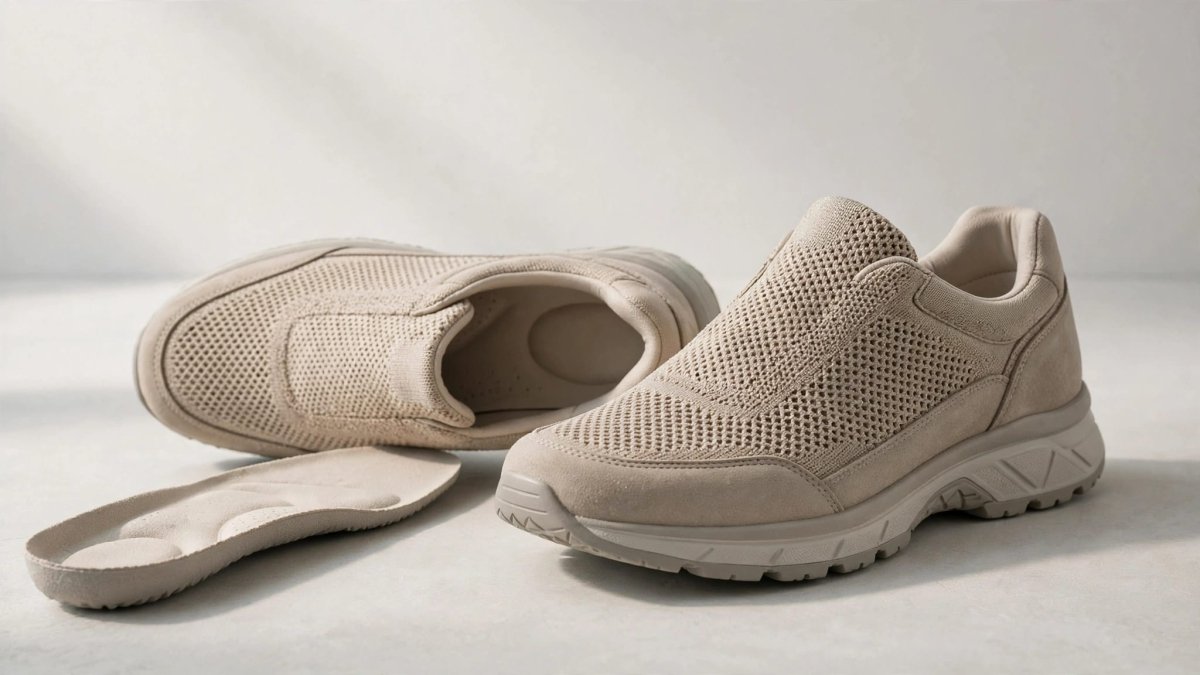
Shoes with removable insoles give you the option to change the layer under your feet, but a good fit depends on the whole shoe. Look for enough interior depth, a secure heel, comfortable toe room, and a shape that works with the insole you plan to wear.
The space inside the shoe matters as much as the removable footbed itself. A thicker insert can change how the upper fits, even when the shoe feels comfortable with its original insole.
Start by deciding what you want the removable footbed to do for you.
What a Removable Footbed Offers
A removable footbed is the layer inside the shoe that sits directly beneath your foot. Depending on the style, it may provide cushioning, arch support, or both. Because you can lift it out, you have the option to replace it with a different insole.
That can be useful if you wear a prescribed orthotic or prefer the feel of a particular over-the-counter insert. It also lets you remove the footbed for airing and replace a worn insert without buying a new pair of shoes.
A removable footbed doesn't guarantee that a shoe will accommodate every replacement. The new insert needs enough room to sit flat, and your foot still needs enough space above it. A shoe with a narrow heel or tapered toe may also be a poor match for an insole with a wider shape.
If you like the original footbed, you can leave it in place. Removability gives you a choice rather than requiring you to make a change.
Match the Shoe to Your Replacement Insole
Bring your insert when you shop for shoes. Its thickness and shape affect the fit in ways that are hard to judge by looking at the shoe alone.
Compare Depth and Instep Space
Remove the original footbed before placing a replacement inside. Stacking one full-length insole on top of another usually takes up extra space and can raise your foot too high in the shoe.
Pay attention to pressure over the top of your foot. A thick insert can make a shoe feel tight across the instep even when the length and width seem right. Your heel may also sit higher against the back of the shoe.
A roomier shoe may accommodate a thicker insert more comfortably than a slim dress shoe. However, extra depth should leave your foot secure, not loose enough to slide around.
Look at the Insole's Shape
Place the replacement inside the shoe and make sure it lies flat. The heel cup should settle into the back without tilting or bunching, and the front should reach the toe area without curling against the sides.
The contours need to meet your foot in the right places, too. An arch that sits too far forward or a raised forefoot pad that presses in the wrong spot can feel uncomfortable even if the insert fits inside.
Our guide to fitting replacement insoles covers how to assess support placement and movement within the shoe.
Test Shoes With Removable Insoles on Your Feet
A shoe can feel comfortable while you're seated and fit differently when you stand. Try both shoes with the socks and insoles you'll wear most often.
Assess the Fit While Standing
Stand with your weight on both feet. Your toes should have room to move, and the sides of the shoe shouldn't squeeze the widest part of either foot. The upper should rest comfortably over your instep without creating a tight band of pressure.
Make sure your heel sits within the insole's heel cup. If a replacement raises it too high, the back of the shoe may no longer hold your foot as securely.
Try both feet because their sizes and shapes can differ. Choose a fit that accommodates the larger foot without leaving the other foot unstable.
Walk, Turn, and Stop
Walk at your usual pace, then turn and stop. Notice whether your heel lifts excessively, your toes touch the front, or the insole moves beneath your foot. A little movement in the shoe is natural, but repeated rubbing or slipping deserves attention.
Also notice where the shoe bends. It should feel comfortable as you push off rather than pressing into your toes or forcing your foot to bend in an awkward spot.
For a closer look at each part of the fit, use our standing and walking fit tips.
Consider the Upper, Closure, and Sole
The footbed is only one part of a comfortable shoe. The upper and sole determine how well the shoe holds your foot and moves with you.
Choose an Adjustable Closure
Laces let you adjust tension across different parts of the foot. Hook-and-loop straps can also make a shoe easier to adjust, especially if you prefer a wider opening.
With either closure, look for a secure fit without having to pull it uncomfortably tight. If the shoe feels loose only when the closure is relaxed, another width or style may fit better.
Remember that tightening a strap changes how the upper holds your foot. It doesn't change the shape of the footbed underneath.
Match the Sole to Your Routine
For everyday walking, look for a sole that feels steady and bends comfortably as you move. The cushioning should feel appropriate for the surfaces and distances you have in mind.
A supportive insert can't compensate for every issue with a shoe's construction. If the heel feels unsteady or the sole feels awkward during a short walk, changing the insole may not solve the problem.
For work, consider the surfaces you'll walk on and any footwear requirements. An attractive removable-footbed shoe still needs a sole suited to your day.
Choose the Right Type of Replacement Insole
Replacement insoles differ in thickness, shape, and firmness. Start with the reason you're changing the original footbed rather than assuming that more cushioning or a higher arch is always better.
Compare Cushioning and Support
A softer insole can add cushioning underfoot, while a firmer, contoured design provides a more defined shape beneath the arch and heel. Some include a raised area near the ball of the foot.
The Pedag Women's Viva Sport insole, for example, has a semi-rigid footbed, arch and metatarsal support, and heel cushioning. Its men's counterpart offers a similar style of support. Either needs enough room inside the shoe to fit without crowding your foot.
Support should feel comfortable in its intended position. If a raised area creates a sharp pressure point, try a different shape rather than assuming you'll get used to it.
Decide Whether You Need a Trim-to-Fit Design
Some full-length insoles have a front section you can trim to match your shoe. The Superfeet Berry trim-to-fit insole, for instance, includes a deep heel cup and comes in sizes covering several women's shoe sizes.
Follow the insert's trimming instructions and remove only the material intended for cutting. Trim gradually, since you can't put material back once it's gone.
A custom orthotic may have different fitting requirements. If yours doesn't sit comfortably in a shoe, ask the clinician who prescribed it for guidance before changing its shape.
Two Removable-Footbed Shoes to Consider
A removable insole is available in more than athletic shoes. These two styles show how the feature can work in different everyday footwear.
Finn Comfort Denia
The Finn Comfort Denia has a removable cork footbed that can be exchanged for a replacement insole. Its hook-and-loop closure offers an adjustable fit, and its wedge shape gives it a different look from a flat walking sneaker.
The design is intended for normal and wider feet. As with any replacement, the insert you choose still needs to sit flat and leave comfortable room around your foot.
This is a useful style to consider if you want an adjustable shoe with a removable footbed for everyday wear.
ECCO Soft 7 Low Bootie
The ECCO Soft 7 Low Bootie offers a removable, leather-covered inlay sole in a bootie. It also has a soft leather lining and an anatomical shape.
A bootie covers more of the foot and ankle than a low shoe, so assess the opening as well as the fit underfoot. If you plan to wear thicker socks, bring them along with your preferred insole.
The original inlay may be all you need. Its removable construction also gives you the option to try another insert when the fit calls for one.
Care for the Footbed and the Shoe
Removing a footbed can make it easier to air out after wear. Take it out when the shoe feels damp and let both pieces dry fully before putting the footbed back.
Cleaning methods depend on the material. A leather-covered insole, cork footbed, and foam insert may need different care, so follow the care instructions for the particular product. Avoid soaking an insert or using high heat unless its instructions allow it.
Look at the footbed periodically for flattening, cracks, worn areas, or a change in how it feels. Uneven wear doesn't automatically mean you need a different kind of support, but it can be a useful reason to reassess the fit.
Replace the insert when it no longer feels comfortable or has worn out. If the shoe's sole or upper has also lost its shape, a new footbed alone may not restore a secure fit.
Find the Fit That Works as a Pair
A removable footbed gives you options, but the best choice is the one that fits comfortably with the insert you intend to wear. Give attention to depth, shape, and how the shoe feels when you walk.
Bring your insoles and everyday socks when you shop. At Tip Top Shoes, you can visit us at 155 West 72nd Street in New York City to compare styles with your preferred insert.


