

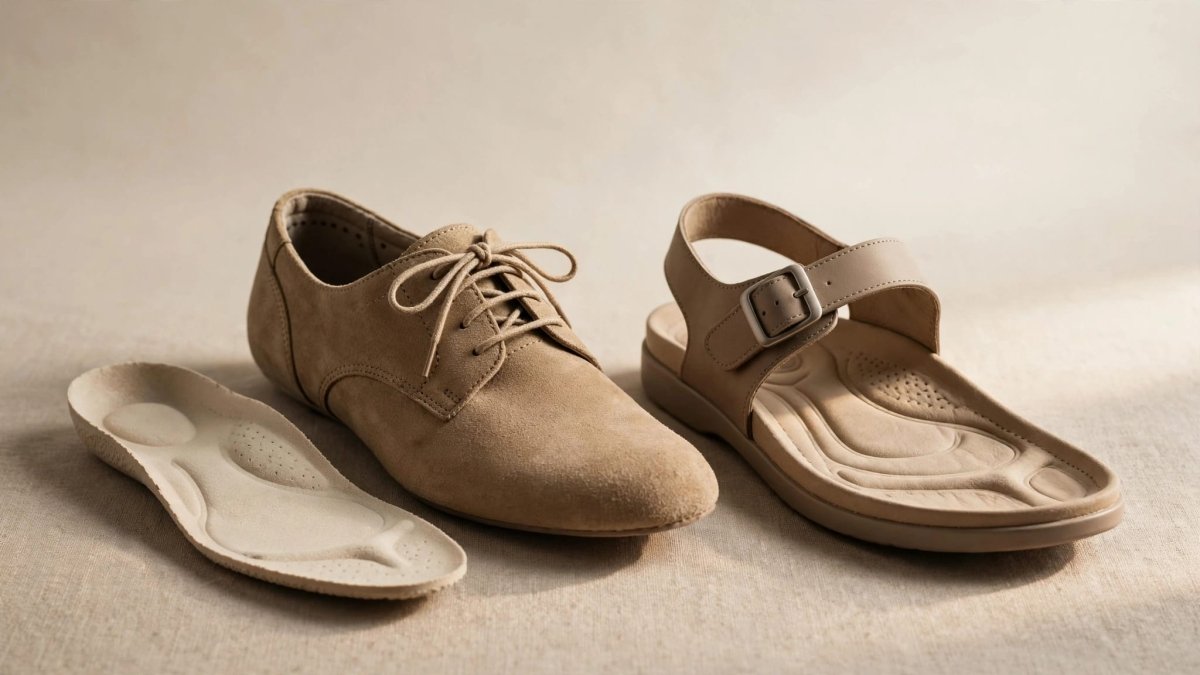
When comparing shoe volume and width, read the shoe's construction details alongside its size label. Adjustable closures, footbed construction, and removable insoles give you concrete features to compare before choosing a pair.
That matters when several shoes share a width designation but offer different ways to adjust or customize them. A product's construction details are more useful than a broad promise of comfort.
Start by separating the width listing from the features described for each shoe.
Key Takeaways
- Read the width designation together with the closure, footbed, and insole descriptions.
- Adjustable straps and laces are different closure options, so compare the actual design rather than relying on the brand name.
- A contoured footbed and a removable inlay are separate features. Look for the one the product description names.
- Keep shoe specifications separate from accessory specifications, especially when comparing replacement insoles.
Read Shoe Volume and Width Descriptions Carefully
A useful product comparison starts with the exact model. Even within one brand, different shoes can have different closures, materials, and footbed designs.
Start with the width field
Our collection includes width labels such as Medium (M), Medium (B), Medium (D), and Wide (W). Read the full label attached to the particular shoe you're considering.
Then keep that information separate from the rest of the description. A width selection doesn't tell you whether the shoe has buckles, a lace-up closure, or a removable inlay. Those are additional product details.
This distinction helps you organize a shortlist without assigning features to a shoe that its description doesn't name. It also makes comparisons between different brands less dependent on familiar labels.
Look for named construction features
Specific wording gives you something useful to compare. "Two adjustable straps with metal tongue buckles" describes a closure more clearly than "personalized comfort."
Similarly, "removable, leather-covered inlay sole" identifies a component and its construction. "Comfortable footbed" leaves more unanswered.
When shopping with shoe volume in mind, prioritize these concrete descriptions. You can compare an adjustable closure with another adjustable closure, or a removable inlay with another removable inlay, without treating general comfort language as a specification.
Adjustable Closures Give You Features to Compare
Laces and buckles both offer adjustment, but their designs differ. Look at where the closure sits and how many adjustment points the shoe includes.
Mephisto Douk: a lace-up closure
Our Mephisto Douk brown leather shoes feature a lace-up closure intended for a customized fit. The model also has smooth leather uppers, a leather lining, and a rubber outsole.
The useful detail here is the closure itself. If laces are a shopping priority, the Douk gives you a named leather lace-up option to consider.
However, keep its other features in their own categories. Leather describes the material, while the lace-up design describes the fastening system. Neither detail should become a blanket claim about every Mephisto shoe.
That approach makes your comparison more precise: identify the model, note the closure, and compare its listed construction with the other shoes on your shortlist.
Birkenstock Arizona EVA: two adjustable straps
The Birkenstock Arizona EVA sandals in white have two adjustable straps with metal tongue buckles. They also feature an EVA footbed and flexible molded EVA construction.
Here, the two-strap design is a clear point of comparison with a lace-up shoe. Each buckle is part of the sandal's fastening system, while the EVA construction describes its material.
The Arizona EVA is also waterproof, which gives shoppers another practical distinction when considering beach or gym footwear.
An adjustable closure identifies something you can fasten differently. It doesn't, by itself, establish a high-volume or low-volume classification.
Footbed Construction Deserves Its Own Comparison
The word "footbed" appears across many footwear descriptions. The details that follow it matter because a contoured footbed and a removable inlay describe different product features.
Birkenstock Arizona Soft Footbed: contoured cork-latex
Our Birkenstock Arizona Soft Footbed sandals feature a contoured cork-latex footbed that adapts to the foot's shape with wear. The design also includes two adjustable straps with metal pin buckles.
That gives you two separate details to record: the footbed construction and the adjustable fastening system.
The Arizona name appears on both this model and the EVA sandal, but the footbed descriptions aren't identical. One lists cork-latex construction; the other lists EVA.
Compare the full product name and description rather than stopping at the shared style name. A familiar name can help you find a design you like, while the model-specific details explain what you're buying.
ECCO Soft 7: a removable inlay
The ECCO Soft 7 black nubuck booties feature a full anatomical last and a removable, leather-covered inlay sole with ECCO Comfort Fibre System.
The removable inlay is the detail to note if that feature is on your shopping list. Its leather covering is another separate specification.
Meanwhile, the anatomical last describes part of the shoe's construction. Don't combine those terms into a broader promise that the description doesn't make.
This is also why exact wording matters when considering shoe volume. "Anatomical," "contoured," and "removable" shouldn't become interchangeable shorthand. Record the feature the shoe actually lists, then compare like with like.
Keep Insoles Separate From the Shoe's Specifications
An accessory listing describes the accessory. It doesn't automatically describe the construction of the shoe you plan to pair with it.
Keeping those descriptions separate makes an insole comparison clearer and prevents a support feature from becoming an assumed shoe feature.
Pedag Viva Full: support-focused construction
Our Pedag Viva full-length insoles include a semi-rigid longitudinal arch structure and heel cushioning. Those are details about the insole's design.
They belong in a different part of your comparison from the shoe's closure, upper material, or width designation.
For example, a lace-up leather shoe and a full-length support insole are two distinct products. Evaluate each product's stated features rather than treating an accessory description as an extension of the shoe listing.
This keeps the shopping decision grounded in the components you're buying, without assuming a particular combination will produce a particular fit.
Pedag Viva Sport: heat-moldable construction
Pedag Viva Sport insoles add another construction detail: a semi-rigid, heat-moldable footbed. Their description also names longitudinal and metatarsal arch support, plus soft heel cushioning.
Those details distinguish the Sport model within an insole comparison. They don't establish that a particular shoe has a removable footbed or a stated volume classification.
Also, "heat-moldable" describes a product feature rather than permission to improvise a heating method. Keep any molding process tied to the instructions supplied with the insole.
The useful comparison is between named accessory features, not assumptions about how an insert will alter a shoe.
Compare Models by Feature, Not Brand Alone
A small comparison table can keep different product details from blending together. Each row should identify the exact shoe and the feature relevant to your decision.
These examples offer different construction details to consider.
| Model | Closure detail | Footbed or inlay detail |
|---|---|---|
| Mephisto Douk | Lace-up closure | Compare separately from its leather upper and lining |
| Birkenstock Arizona EVA | Two adjustable buckle straps | EVA footbed |
| Birkenstock Arizona Soft Footbed | Two adjustable buckle straps | Contoured cork-latex footbed |
| ECCO Soft 7 Low Bootie | Consider alongside its other listed features | Removable leather-covered inlay |
The takeaway is that a brand name doesn't replace a model-level comparison. Even the two Arizona examples have different footbed descriptions.
Also, an unfilled specification isn't a negative feature. If a product description doesn't establish whether a component removes, don't turn that absence into a claim that it does or doesn't.
Keep separate categories for materials, closures, and footbeds. Otherwise, it's easy to compare a material in one shoe with a fastening feature in another and overlook the distinction that matters to your purchase.
Build a Shortlist Around Clear Product Priorities
Before comparing models, decide which documented features you want to prioritize. A lace-up leather shoe, a waterproof EVA sandal, and a bootie with a removable inlay offer different shopping starting points.
Keep that priority narrow enough to be useful. "Two adjustable straps" is a clear requirement. "The same comfort as another shoe" is much harder to match through a product description.
Then read the complete model name. Arizona EVA and Arizona Soft Footbed share a recognizable design name, but their listed constructions differ.
Customer reviews can add individual perspectives, although one person's experience doesn't establish a specification for every wearer. Give the product's stated features more weight when comparing closures, materials, and removable components.
If you prefer to compare footwear in person, our store is at 155 West 72nd Street in New York City. Bring your shortlist so you can keep the exact models and features in view.
Frequently Asked Questions
Does an adjustable closure mean a shoe has a high-volume fit?
An adjustable closure establishes a fastening feature. It doesn't automatically establish a volume classification. The Mephisto Douk lists laces, while the featured Arizona sandals list adjustable buckle straps. Keep those descriptions separate from broader fit assumptions.
Does "anatomical" mean a shoe has a removable insole?
Those are separate specifications. The ECCO Soft 7 bootie lists both an anatomical last and a removable leather-covered inlay. Look for explicit removal language rather than treating "anatomical" as a substitute for it.
Are the Arizona EVA and Arizona Soft Footbed constructed alike?
Their descriptions name different footbed materials. The Arizona EVA has an EVA footbed, while the Arizona Soft Footbed has a contoured cork-latex footbed. Both featured models include two adjustable straps, so the shared closure style doesn't make their constructions identical.
Choose With the Complete Product Description
Shopping for shoe volume calls for attention to the whole product description. Keep width labels, closures, footbeds, and accessories in separate categories so each comparison stays clear.
Prioritize named construction features over broad comfort promises. That gives you a more useful shortlist and a clearer understanding of what each shoe offers.


