

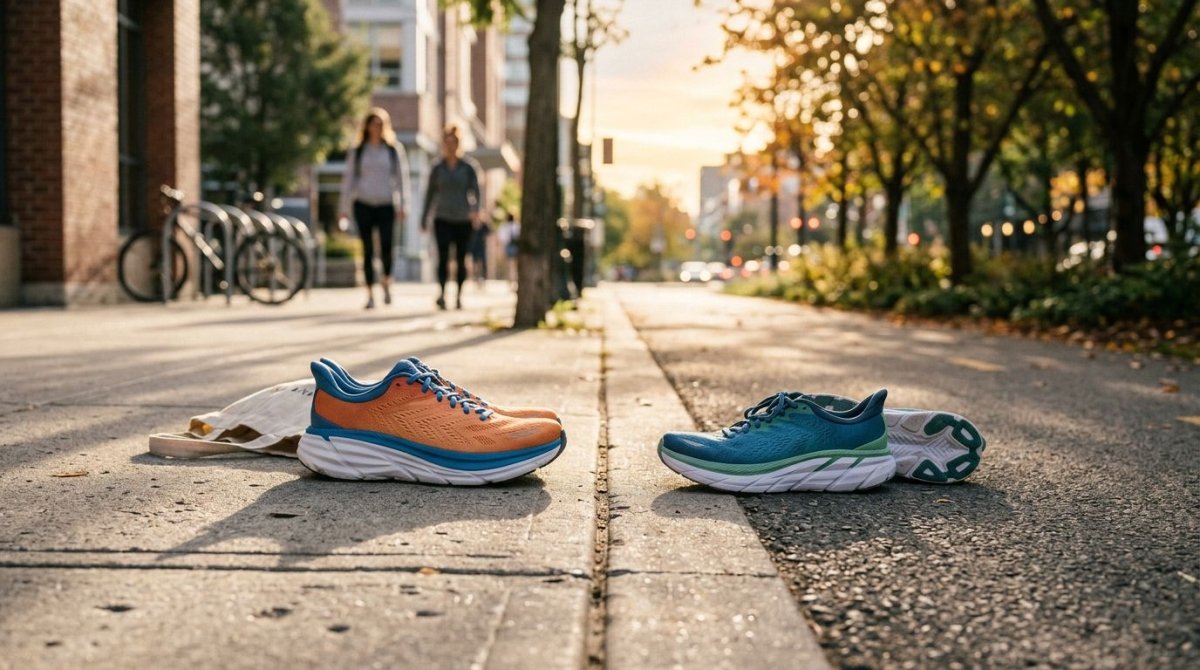
Hard sidewalks can make a shoe feel comfortable at breakfast and unforgiving by dinner. That gap matters when your day includes commuting, errands, standing, and an evening run.
Well-chosen Hoka walking shoes soften repeated pavement impact and promote a smooth stride. Still, a tall foam sole alone doesn't guarantee the right fit, stability, or running feel.
Start by matching the shoe to the activity that fills most of your week.
How Hoka walking shoes change the feel of pavement
HOKA is known for thick midsoles, rockered soles, and a sensation of forward movement. Those features can make concrete feel less harsh, especially during long walks when your legs are already tired.
Rocker geometry supports a smoother stride
Many HOKA models use MetaRocker geometry, which curves the sole to help your foot roll through each step. Instead of feeling flat underfoot, the shoe has a rounded transition at the heel and forefoot.
That movement suits people who walk at a steady pace on sidewalks, airport floors, and paved paths. It can also feel natural for runners who prefer a smooth turnover rather than a firm, flexible ride.
However, rocker shoes have a distinct feel. Walk around long enough to judge them at your normal pace before deciding they are right for you.
A tall sole still needs a secure fit
More foam places your foot higher off the ground. Therefore, heel hold and midfoot security matter as much as underfoot softness. If your heel slides, a heavily cushioned shoe can feel unstable even when its foam feels excellent.
A thicker midsole can feel less stable when your heel shifts inside the upper, so secure lockdown matters as much as cushioning depth.
Use the laces to lock the heel into place, but don't pull them so tightly that the top of your foot feels pressure.
Compare cushion and stability before you buy
HOKA's current U.S. price listings offer a useful starting point for comparing popular daily models. Retail prices and color availability can change, so use these figures as a reference rather than a promise.
| Model | U.S. listed price | Best starting point |
|---|---|---|
| Bondi 9 | $175 | Neutral cushioning for walking and everyday running |
| Clifton 10 | $155 | Balanced neutral shoe for walking and daily miles |
| Gaviota 6 | $180 | Stable ride with more built-in guidance |
| Arahi 8 | $150 | Lower-priced stability option |
The Bondi and Clifton both suit walking and everyday road running, yet they create different sensations. The Bondi is the more plush choice, while the Clifton has a lighter, more balanced character.
Cushioning and stability do different jobs
Cushioning affects how soft or protective a shoe feels underfoot. Stability features help guide the foot through its stride. A shoe can have abundant foam and still be neutral, or it can combine cushioning with added structure, as our Hoka cushioning and stability guide explains in more detail.
Choose the feel that keeps you comfortable during your usual routine. A stability model isn't automatically better for every walker, and a neutral shoe isn't automatically less supportive.
Choose cushioning for total time on your feet
Long city days often involve more standing than people expect. Subway platforms, office floors, museum visits, and evening plans can add hours to a modest step count.
Bondi 9 favors plush, all-day comfort
The Bondi 9 is HOKA's neutral max-cushion option for everyday running and walking. At $175, it has a 5 mm heel-to-toe drop and weighs about 10.5 ounces in men's sizing and 9.3 ounces in women's sizing.
For people who want soft protection underfoot, Women's Bondi 9 shoes for walking and running are a strong option. The model uses a premium foam midsole, Smooth MetaRocker geometry, an engineered mesh upper, and durable rubber where the sole sees repeated contact.
Bondi works best when comfort takes priority over a low-to-the-ground feel. Its substantial platform can be welcome after a long shift or a full day on pavement.
Balanced cushioning often feels more versatile
Some walkers prefer a shoe that feels less bulky during quick errands and shorter runs. In that case, a balanced daily trainer can make more sense than maximum cushioning.
The Clifton line sits in that middle ground. It has enough foam for consistent pavement use, yet it remains lighter and less imposing than the Bondi. That balance matters when your shoes need to handle a morning walk, a few running miles, and the rest of your day.
A single Hoka for walking and running
Many Hoka walking shoes can also handle easy road running. The key is matching the shoe to the way you run, not assuming every comfortable walker will feel right once your pace increases.
Clifton 10 is an easy crossover choice
The Clifton 10 is a neutral daily trainer that HOKA lists for walking and everyday running. Its current U.S. list price is $155, which places it below the Bondi and Gaviota.
Women's Hoka Clifton 10 daily trainers combine a flexible jacquard-knit upper, CMEVA midsole foam, reflective details, and abrasion-resistant rubber. The rearfoot-focused Active Foot Frame helps create a secure heel feel without turning the shoe into a firm stability model.
Choose Clifton if you run several times a week but also need a comfortable shoe for routine walking. It has the softer HOKA character without the Bondi's higher-volume feel.
One pair works when the demands overlap
A single pair makes sense when your runs are relaxed, your walking is mostly on pavement, and your preferred feel stays consistent at different speeds. In that situation, a Clifton can cover both activities well.
Separate pairs make more sense if one activity has different demands. For example, a person who prefers plush shoes for workdays may still want a lighter or more responsive model for faster runs. Trail running also calls for a shoe with terrain-focused traction rather than a road-oriented daily trainer.
Select stability only when it matches your stride
Stability footwear can be helpful when it feels natural underfoot. It should guide your step without creating pressure beneath the arch or along the inside of the ankle. If arch support is your bigger concern, our Aetrex arch support insoles and shoes guide compares neutral and posted options for daily walking.
Gaviota 6 provides a more guided ride
HOKA classifies the Gaviota 6 as stable, and it currently lists at $180. The shoe uses H-Frame technology to add support for overpronation without relying on a rigid medial post.
Men's Gaviota 6 stability walking shoes also include an internal lacing system, padded collar, compression-molded foam, high-abrasion rubber, and reflective details. Those features make it a practical choice for daily running, walking, and casual wear.
The Gaviota has more structure than the Bondi or Clifton. That extra guidance can feel reassuring during long walks if your foot tends to move inward or your neutral shoes feel loose through the heel.
Arahi offers another stability route
The Arahi 8 is the lower-priced stability choice in this group, with a current U.S. list price of $150. Try it alongside the Gaviota if you want added guidance but prefer a different fit or ride.
Don't diagnose your needs by looking only at an old outsole. Worn rubber can show how a shoe met the pavement, but it doesn't explain how your foot felt inside it. Persistent pain, numbness, or imbalance deserves advice from a qualified medical professional.
City days require more than a soft midsole
A long urban day includes abrupt stops, curbs, stairs, crowded sidewalks, and time spent standing still. A shoe should feel secure in those moments, not merely soft during a straight walk.
Solimar 2 suits a more compact everyday feel
If maximum cushioning feels too large for your wardrobe or routine, the Solimar 2 offers a more approachable stack height and balanced midsole. It is built for walking, training, errands, and general daily movement.
Women's Hoka Solimar 2 trainers feature compression-molded EVA foam, a breathable mesh upper, an adjustable eyestay, a plush heel, and extra rubber in high-wear areas. That combination makes sense for shoppers who want HOKA comfort in a less bulky silhouette.
Let your route guide the choice
Road shoes work best for pavement, indoor floors, and maintained paths. If your regular route includes wet leaves, loose gravel, or unpaved trails, inspect the outsole pattern before buying. A smooth road outsole won't offer the same purchase as a trail-focused design.
Also consider where you will wear the shoe after your walk. A black Solimar may blend easily into a workday wardrobe, while a reflective Clifton can make more sense for early-morning or evening runs.
Fit Hoka shoes when your feet are at their largest
Fit decides whether a good model becomes a favorite or stays in the closet. Try shoes later in the day, or after your usual walk, when your feet are more likely to be full-sized.
Use a five-point fit check
Wear the socks you plan to use most often. If you wear orthotics, bring them along for the try-on.
- Leave about a thumbnail's width between your longest toe and the front of the shoe.
- Keep your heel secure without a hard edge pressing into the Achilles area.
- Make sure the widest part of your foot sits comfortably in the widest part of the upper.
- Walk briskly and turn a corner to check whether your foot shifts on the platform.
- Notice any toe pressure on a downhill ramp or stair descent.
A snug performance fit can work for running, but city walking often calls for a little more room. Your feet need space to expand during hours of standing and walking.
Pay attention to early warning signs
Mesh uppers may relax a little with use, yet shoe length will not change. Don't buy a pair that makes your toes curl or creates a hot spot during the first fitting.
HOKA walking shoes should feel supportive immediately, with no need to tolerate rubbing in hopes of a long break-in period. A proper width and secure heel are usually more useful than sizing up excessively for extra toe room.
Find the Hoka that fits your real day
A long walk can become an entire day on your feet, which is why the right shoe needs more than soft foam. Fit, ride, and purpose determine whether a pair feels good after several hours.
Choose Bondi for plush protection, Clifton for balanced walking and running, Gaviota for added stability, or Solimar for a more compact everyday option. The best pair is the one that stays comfortable through the activities you actually do.


