

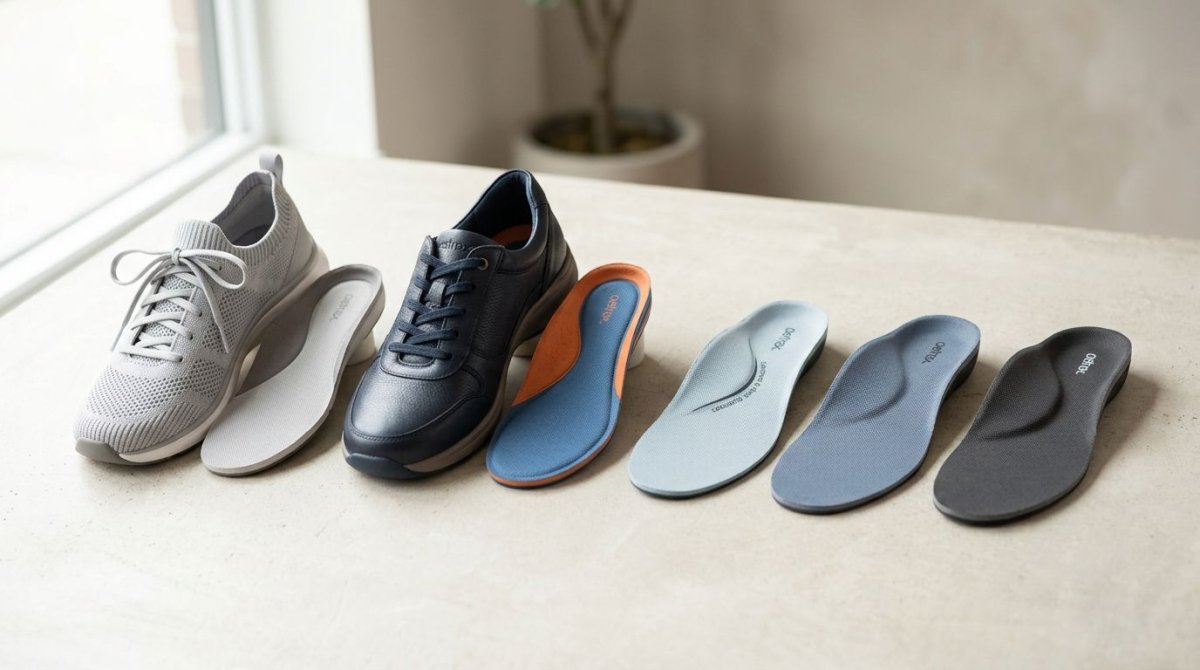
The right Aetrex arch support can make long walks, commutes, and full workdays feel more manageable. The important choice is matching the support to your arch height, foot pressure, walking habits, and available shoe space.
Aetrex makes both supportive shoes with built-in footbeds and removable orthotics for casual or athletic footwear. Carly and Danika are popular walking styles, while the brand's L400, L405, and L420 insoles target different support needs. Start with the basics of the Aetrex system, then choose the option that matches your feet.
How Aetrex arch support works
Aetrex builds its support system around a shaped area under the arch. The brand calls this Signature Arch Support, and its position is designed to support the arch while helping reduce excessive inward rolling, also called pronation.
The feel can vary by model. Some insoles have a neutral shape for medium or high arches, while posted designs provide more guidance for low arches and flat feet.
Signature Arch Support and cushioning
Aetrex says its Signature Arch Support is positioned at the apex of the arch. That placement helps distribute pressure through the foot instead of leaving the heel and forefoot to absorb the load alone.
Cushioning also matters for daily walking. Select Aetrex shoes use UltraSKY cushioning or an UltraSKY EVA foam midsole to absorb impact around the heel and forefoot. This creates a softer step without relying on arch support alone.
The brand's orthotics are listed at $69.95 on its official site. Aetrex also says its designs draw from more than 50 million foot scans. That figure describes the data behind the product development, not a guarantee that one model will suit every foot.
Built-in support versus removable support
A supportive shoe can be convenient because the footbed is already shaped for the intended fit. A removable insole gives you more control, especially when you want to adjust an existing pair of walking shoes.
Carly Arch Support Sneakers include a built-in orthotic system, a removable insole, UltraSKY cushioning, rubber pods, a padded heel, and a .8-inch heel height. Aetrex also lists the Carly as machine washable. Product information positions it for concerns such as arch discomfort, heel pain, bunions, flat feet, and high insteps, but those descriptions aren't medical promises.
How to choose an Aetrex insole
Aetrex organizes its orthotics by arch height and forefoot needs. The model codes can look confusing at first, but they follow a useful pattern.
The first decision is whether your feet have medium or high arches, or low arches and flat feet. Next, consider whether you feel pressure beneath the ball of your foot.
Medium and high arches
The L400 family uses a neutral design for medium and high arches. It suits shoppers who want cushioning and arch contact without a posted support structure.
The women's L400W Sport Neutral is designed for medium and high arches, with rearfoot cushioning and a neutral forefoot. It may be a good match for everyday sneakers, walking shoes, and athletic footwear when your main need is arch support.
For active use, the Aetrex Women's L405W Sport Neutral Insole adds forefoot support for shoppers who experience pressure around the ball of the foot. It also includes a cupped rearfoot design and a CopperGuard top cover.
Men can compare the Aetrex Men's L400 Sport Neutral Insole for sport footwear or the Aetrex Men's L405 Casual Neutral Insole for casual shoes. Both options target medium and high arches, while the L405 adds forefoot support.
Low arches and flat feet
Low arches need a different structure than high arches. A neutral insole can feel comfortable, but it may not provide enough guidance if your foot rolls inward during walking.
Aetrex's "20" models use a posted or supported design for low arches and flat feet. The L2320 Premium Memory Foam Posted Insole is listed at $79.95 and is intended for low arches to flat feet without ball-of-foot pain. Its posted heel is designed to help control overpronation and improve balance.
The men's L420 follows the same general idea. The Aetrex Men's L420 Sport Posted Insole is designed for low or flat arches and includes a posted rearfoot structure for overpronation control.
A posted insole can feel more noticeable than a neutral model. Give yourself time to assess the fit, and stop using it if it causes new or worsening discomfort.
When metatarsal support matters
Some Aetrex designs include support beneath the forefoot. This feature helps redistribute pressure around the ball of the foot, which can matter when walking on hard pavement or standing for long periods.
The women's L405W includes metatarsal support. Aetrex's L2305 Premium Memory Foam with Metatarsal Support is listed at $79.95 and has 43% more memory foam in the forefoot than the previous version. It also uses an antimicrobial CopperGuard lining, IQ150 memory foam, and an Aerocell polyurethane base.
Choose a forefoot-supported model when pressure in that area is part of your comfort problem. If your forefoot feels fine, a neutral model may provide a less noticeable fit.
Aetrex shoes for daily walking
Aetrex walking shoes combine footbed support with the fit and cushioning of the shoe itself. This makes them useful when you want an all-in-one option instead of adapting several pairs with separate inserts.
Look for a removable footbed when you want the option to test another orthotic later. Also check the upper, outsole, width, and heel height because arch support can't compensate for a cramped toe box or unstable fit.
Carly and Danika
The Carly Arch Support Sneaker is one of Aetrex's most feature-rich walking options. It has a built-in orthotic system, UltraSKY cushioning, microfiber lining, rubber pods, a padded heel, and a removable insole. The .8-inch heel height gives it a small lift while keeping the shoe suitable for daily wear.
The Danika Arch Support Sneaker is another women's walking style from Aetrex. Aetrex has listed the Danika at $149.95. The women's walking collection identifies Carly and Danika among styles available in wide and extra-wide widths, although width options can vary by color and size.
These shoes can work well for errands, travel, and regular city walking. For longer walks, compare the fit at the heel and forefoot as carefully as the arch area.
Other women's styles to consider
Aetrex's women's new-arrivals collection includes several supportive silhouettes at different price points:
| Style | Design | Listed price |
|---|---|---|
| Kinsley | Arch support sneaker | $129.95 |
| Aubrey | Arch support platform sneaker | $149.95 |
| Helena | Arch support slip-on | $139.95 |
| Collette | Arch support loafer | $149.95 |
The Kinsley and Aubrey offer sneaker styling, while the Helena gives you a slip-on format for quick errands. Collette has a loafer profile that can work with casual office clothing. Prices and availability can change, so check the product listing before purchasing.
Fit considerations for walking shoes and insoles
Arch support should feel supportive, not painful or sharply intrusive. A good fit also leaves enough room for your toes to spread naturally without allowing the heel to slide.
Your current shoe may not have enough interior volume for a thick replacement insole. If the top of your foot feels compressed, the shoe may be too shallow for that orthotic.
Removable footbeds create more options
When a shoe has a removable footbed, take it out before adding an Aetrex insole. Leaving both footbeds inside can raise your foot too high and reduce interior space.
A replacement insole should sit flat from heel to toe. Check that the heel cup fits securely and that the forefoot support rests in the correct area. If the insert shifts while walking, the shoe may be too wide, too flexible, or incompatible with that insole.
Carly includes a removable insole, which gives you more flexibility than a permanently fixed footbed. That doesn't mean every replacement orthotic will fit, so compare the shoe's interior shape with the insert you plan to use.
Width matters as much as arch height
A narrow shoe can create pressure across the toes and forefoot. A wide shoe can allow too much movement, which may make even well-designed arch support feel unstable.
Select Aetrex women's walking styles come in wide and extra-wide widths. The availability isn't universal across the collection, so confirm the width for the exact style and size you want.
When trying on walking shoes, wear the socks you normally use. Walk on a firm surface and pay attention to heel movement, toe room, and pressure over the instep. A comfortable arch is only one part of a successful fit.
Aetrex shoes or separate insoles?
Choose an Aetrex shoe with built-in support when you want a coordinated design and don't need to modify your footwear. Carly, Danika, and other women's styles combine the shoe's upper, outsole, cushioning, and support in one package.
Separate insoles make more sense when you already own shoes that fit well or when you want different support levels for different activities. For example, you might use a neutral L400 in a casual sneaker and a posted L420 in a sport shoe for low-arch support.
Insoles also make it easier to replace worn cushioning without replacing the entire shoe. However, they can change the way a shoe fits. Check the interior volume before ordering, especially with slim casual shoes or dressier footwear.
The best option depends on your starting point:
- Choose built-in support for a ready-to-wear walking shoe.
- Choose a neutral insole for medium or high arches without major forefoot pressure.
- Choose a posted insole for low arches, flat feet, or overpronation concerns.
- Choose a supported forefoot design when pressure beneath the ball of the foot is part of the problem.
A practical Aetrex shopping guide
Start by identifying your arch type. A wet-foot test can offer a rough clue, but it doesn't replace a professional assessment. If you already know that you have low arches, high arches, or a tendency to overpronate, use that information when comparing models.
Next, decide whether you need neutral, posted, or forefoot-supported construction. Aetrex's code system can help:
| Aetrex code | General design | Best suited to |
|---|---|---|
| 00 | Neutral and cupped | Medium or high arches |
| 05 | Cupped and supported | Medium or high arches with forefoot pressure |
| 20 | Neutral and posted | Low arches or flat feet |
| 25 | Posted and supported | Low arches or flat feet with forefoot pressure |
Then match the insole to the shoe. A sport insole may suit running shoes and active sneakers, while a casual model may sit more naturally inside everyday footwear.
Finally, assess the whole fit. Make sure the shoe has the right width, enough toe room, a stable heel, and enough space for the orthotic.
Key Takeaways
- Aetrex arch support varies by model, so arch height should guide your choice.
- L400 and L405 models target medium and high arches.
- L420 posted support is designed for low arches and flat feet.
- L405 and L2305 designs add forefoot or metatarsal support.
- Carly and Danika are Aetrex walking styles with built-in support.
- Select women's styles come in wide and extra-wide widths.
- A removable footbed gives you more flexibility, but the replacement insole must fit the shoe's interior.
Frequently asked questions
Are Aetrex shoes good for daily walking?
Aetrex shoes are designed with features aimed at daily comfort, including shaped footbeds, cushioning, padded heels, and supportive outsoles. Carly and Danika are examples from the women's walking collection. The right choice still depends on your arch type, width, walking surface, and individual comfort.
Which Aetrex insole is best for high arches?
The L400 and L405 families are designed for medium and high arches. Choose an L400 neutral model when you want arch cushioning without added forefoot support. Consider an L405 when you also want metatarsal support beneath the ball of the foot.
Which Aetrex insole is best for flat feet?
A posted model is the better starting point for low arches or flat feet. The L420 is a men's sport option designed for low arches and overpronation concerns. Aetrex also offers the L2320 Premium Memory Foam Posted Insole for low arches to flat feet without forefoot pain.
Can I put Aetrex insoles in any shoe?
No. The shoe needs enough interior space, a removable footbed, and a shape that matches the orthotic. Remove the original footbed when possible, then check that the Aetrex insole lies flat and doesn't crowd your toes or raise your heel excessively.
Does arch support help plantar fasciitis?
Aetrex product pages position some shoes and insoles for support related to plantar fasciitis and foot discomfort. Those statements don't guarantee a medical result. If pain continues, worsens, or affects your walking, consult a podiatrist or other qualified healthcare professional.
Choose support that matches your feet
The most comfortable Aetrex option isn't necessarily the thickest or most structured model. Medium and high arches often pair well with the neutral L400 or supported L405, while low arches may need a posted design such as the L420. Forefoot pressure, width, and shoe volume can change the decision.
For daily walking, start with the fit you can wear comfortably for several hours. Aetrex shoes offer a built-in route, while separate insoles give you more control across multiple pairs. When the support, width, and cushioning work together, your walking shoes feel ready for the miles ahead.


