

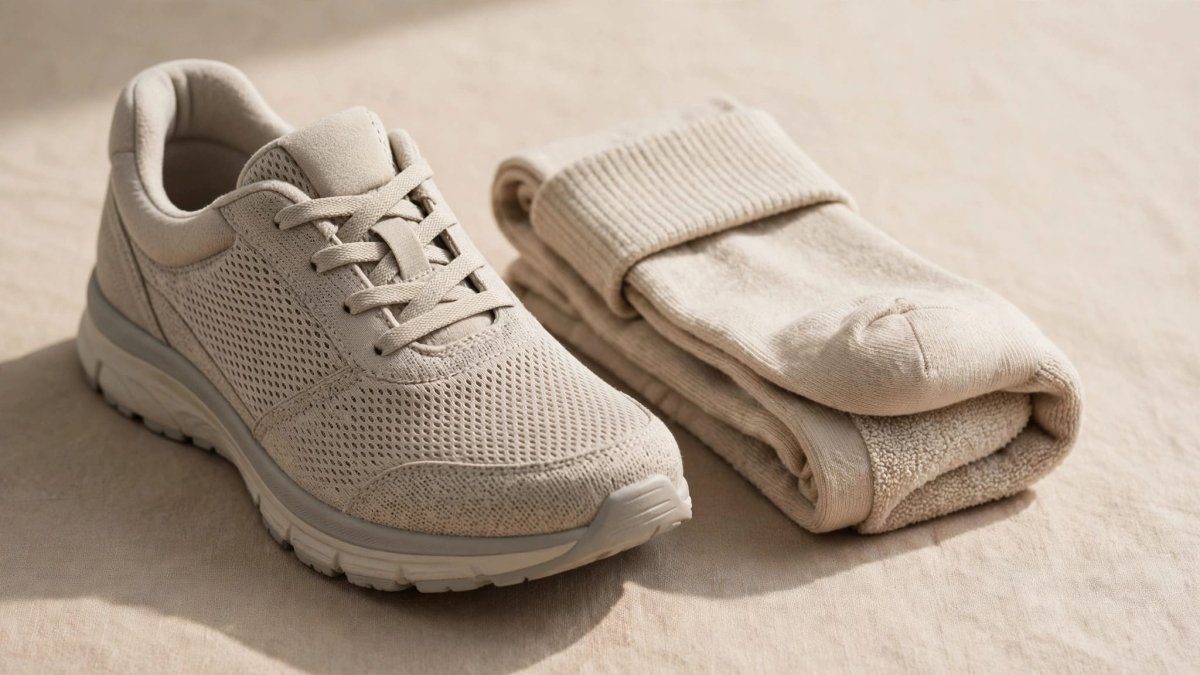
To prevent shoe blisters, choose shoes that hold your feet comfortably and socks that reduce rubbing at seams. Focus on where friction starts, because underfoot cushioning alone won't stop a rough toe seam or uncomfortable heel collar.
The shoe and sock need to work together, especially when you're shopping for everyday walking shoes. Start by noticing exactly where discomfort develops, then compare the features that address that area.
Key Takeaways
- Choose shoes that feel comfortable around the heel, toes, and sides of your foot, rather than judging softness alone.
- Look for socks with an anatomical shape and smooth toe construction to reduce bunching and seam irritation.
- Treat cushioning, support, and friction control as separate features. A shoe or sock can provide one without solving every source of discomfort.
Why Shoe Friction Causes Blisters
A friction blister develops when repeated shear damages the skin and fluid collects between its layers. Although people often describe this as surface rubbing, movement within the skin also matters.
Repeated movement stresses the same area
With each step, your foot moves against the sock and shoe. When that movement repeatedly stresses one spot, the skin can become irritated and eventually blister.
The back of the heel, sides of the toes, and ball of the foot are common trouble spots. However, the location depends on your foot shape and where the footwear makes contact.
A shoe doesn't have to feel hard everywhere to cause trouble. One collar edge or internal seam can concentrate friction in a small area.
Pressure and friction need separate attention
Pressure is the force against your foot. Friction affects how surfaces resist sliding against each other, which can contribute to skin shear during movement.
These forces often act together, but softness doesn't address both equally. A cushioned sole may feel pleasant while an uncomfortable upper continues to irritate the toes.
Shock absorption under the heel doesn't protect the skin from friction at the heel collar.
Choose Shoes Around Your Foot's Contact Points
When shopping, pay attention to the upper and lining as closely as the sole. The parts touching your skin or socks deserve more attention than a broad comfort label.
Notice the heel collar, tongue, and lining
Feel inside the shoe for prominent seams, folded lining, or firm edges. Then pay attention to those areas while walking in the pair.
The collar should feel comfortable around the heel. Meanwhile, the tongue should lie smoothly across the top of your foot without an uncomfortable edge pressing against it. A soft lining can improve the feel, but its placement and construction still matter.
Our Mephisto Match men's walking shoes combine a full-grain leather upper with a padded tongue and collar. Their speed-lacing closure also allows an adjustable, secure fastening. These are useful features to consider alongside how the shoe feels on your own foot.
Give the toes and forefoot equal attention
Heel comfort can distract you from problems farther forward. Notice whether your toes feel pinched, whether the sides press uncomfortably, or whether an internal seam crosses a sensitive area.
Your toes should rest comfortably rather than feel compressed together. Also, pay attention to the top of the toes, where the upper or sock seam may make contact.
Judge the complete walking experience. A comfortable standing position doesn't reveal every contact point that appears when the shoe bends during a step.
Choose Socks That Reduce Seam Irritation
Socks form the layer between your foot and the shoe. Their shape, seams, and cushioning influence how that contact feels throughout a walk.
Look for an anatomical shape
A sock that follows the foot's shape can sit more smoothly than one that gathers into folds. Anatomical construction and targeted compression are features worth comparing when bunching causes discomfort.
Our Feetures Elite Light Cushion socks use an anatomical design and targeted compression. They combine that construction with lightweight, high-density cushioning.
These details address different concerns. The shaped construction supports a close, consistent fit, while the cushioning adds softness without making maximum padding the main feature.
However, no sock can guarantee blister prevention. An uncomfortable shoe edge or repeated pressure against a toe can remain a problem even with a well-designed sock.
Pay attention to the toe seam
A raised toe seam can create a concentrated point of irritation. This matters when it sits against the top or end of a toe during walking.
Feetures uses its Perfect Toe construction in the Elite styles discussed here. The seamless toe design removes a conventional raised seam from that area.
When comparing socks, distinguish a smooth toe construction from general softness. A soft fabric can still have a seam that bothers your foot.
Also, wear the socks you intend to use when trying shoes. That lets you assess the actual combination rather than judging the shoe and sock separately.
Compare Light and Maximum Sock Cushioning
More cushioning changes the feel of a sock, but it doesn't automatically provide better friction protection. Seam construction and anatomical shaping deserve their own place in the decision.
The Feetures Elite Max Cushion socks offer a more heavily cushioned option. Like the Light Cushion style, they feature anatomical shaping, targeted compression, and a seamless toe.
These two styles share several construction details.
| Feature | Elite Light Cushion | Elite Max Cushion |
|---|---|---|
| Cushioning | Lightweight cushioning | Maximum cushioning |
| Shape | Anatomical design | Anatomical design |
| Targeted compression | Included | Included |
| Toe construction | Seamless toe | Seamless toe |
| Height | No-show tab | No-show tab |
The main distinction is cushioning level, rather than a choice between seamless and conventional toe construction.
Choose the feel you prefer while keeping the source of irritation in mind. If a toe seam has been the problem, the seamless toe is the relevant feature in either style.
By contrast, choosing maximum cushioning solely because the name sounds more protective can overlook the actual friction point.
Read Comfort Features for the Job They Do
Shoe descriptions often group cushioning, support, and fit together. Separating those features makes it easier to compare products without expecting one detail to solve every problem.
Separate impact protection from skin comfort
Shock-absorbing soles address the impact of walking. Supportive footbeds influence how the foot rests inside the shoe. Meanwhile, linings, seams, and collars determine important points of contact.
All can contribute to comfort, but they perform different jobs.
For blister prevention, pay particular attention to the features nearest the irritated skin. If discomfort develops behind your heel, a description of underfoot cushioning provides only part of the information you need.
Similarly, an anatomical sock may offer a close fit, yet the shoe's upper still needs to feel comfortable against your foot.
Use reviews as context for your own fit
Customer reviews can highlight areas worth noticing, such as a firm collar or pressure across the toes. However, another person's comfort doesn't establish how the same shoe will feel on you.
Foot shape, toe position, and sensitivity differ between shoppers. Even an enthusiastic review can't replace attention to your own contact points.
Look for concrete observations rather than a star rating alone. A comment about where a shoe feels snug is more informative than a general statement that it's comfortable.
At our store at 155 West 72nd Street, you can compare how different shoes feel while walking.
Make Friction Points Part of Your Shopping Decision
A useful comparison starts with the location of your usual discomfort. That keeps the shopping decision focused instead of turning every comfort feature into an equal priority.
For heel irritation, consider the collar's shape, lining, and feel during movement. For toe irritation, pay closer attention to the forefoot shape, internal seams, and sock toe construction.
Also, distinguish a recurring problem from a new one. If several pairs bother the same area, that pattern deserves attention. It can help you explain the concern when seeking fitting assistance or medical advice.
Keep your observations concrete: "The collar presses against the back of my heel" gives clearer direction than "These aren't comfortable."
You don't need a long feature list to make a useful comparison. You need a shoe-and-sock combination that feels comfortable at the places where friction usually develops.
Frequently Asked Questions
Why do I get a blister on only one foot?
Your feet can differ in shape, size, or movement. As a result, the same shoe model may contact each foot differently.
A sock fold or an uneven section of lining can also affect just one side. Pay attention to the exact location rather than assuming both shoes will feel identical.
If blisters repeatedly develop in the same place despite otherwise comfortable footwear, a podiatrist can assess the cause.
Can no-show socks protect the back of the heel?
They can provide a fabric barrier where they cover the skin. However, a no-show sock won't protect an area that sits above its edge.
The relationship between sock height and shoe collar matters more than the "no-show" name alone. Notice whether the collar touches fabric or exposed skin during movement.
A tab can add coverage at the back, but its position still needs to match the shoe's contact area.
When does a blister need medical attention?
Seek medical care for increasing redness, warmth, swelling, pus, or worsening pain. Fever or spreading redness also needs prompt attention.
People with diabetes, reduced sensation, or poor circulation should seek professional advice promptly for foot blisters. These conditions can make a small skin injury more serious or harder to notice.
Repeated blisters also deserve attention when you can't identify the cause or they interfere with ordinary walking.
Choose Comfort Where Friction Starts
The most useful way to prevent shoe blisters is to focus on contact points. Comfortable uppers, smooth sock construction, and an appropriate closure each address a different part of the problem.
Compare cushioning separately from seam irritation and heel contact. A shoe-and-sock combination that feels comfortable throughout a step gives you a stronger basis for choosing than softness alone.


