

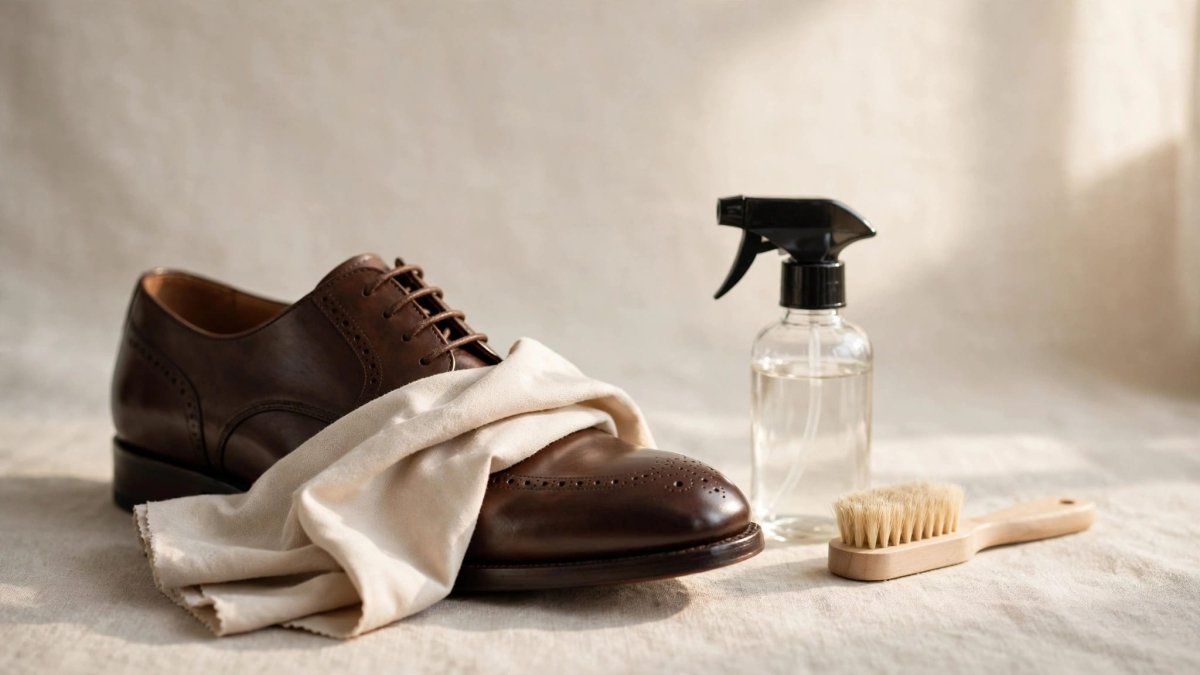
To clean leather shoes without stripping the finish, choose care products made for the leather's surface and use the gentlest approach the shoe allows. A smooth dress shoe, an oiled boot, and a suede loafer don't all respond to the same treatment.
The goal is to remove dirt while preserving the shoe's color and texture. Start by identifying the finish before choosing a cleaner or polish.
Identify the Leather Finish First
The upper's finish determines which care products are appropriate. Even two black leather shoes can need different treatment if one has a smooth surface and the other has a brushed finish.
This comparison will help you recognize common finishes and choose a care approach.
| Finish | Typical appearance | Care consideration |
|---|---|---|
| Smooth leather | Even surface with a matte or polished look | Choose products intended for smooth leather. |
| Suede | Soft, visibly fuzzy surface | Use products labeled for suede; avoid smooth-leather cream. |
| Nubuck | Fine, brushed surface with a soft feel | Use nubuck-specific care to preserve its texture. |
| Oiled leather | Often matte or naturally varied in color | Choose products intended for oiled leather and expect some to alter its appearance. |
| Patent leather | Glossy, coated surface | Choose care products labeled for patent leather. |
The distinction matters more than the shoe's style. A boot can be smooth leather, nubuck, or oiled leather, so a product labeled only for "boots" isn't enough information by itself.
For example, our ECCO Soft 7 black bootie has a nubuck upper. A cream intended for a polished oxford could darken its surface or flatten the brushed texture.
The ECCO Helsinki 2.0 oxford comes in leather or brushed nubuck versions. Choose care products for the finish on your pair rather than assuming every Helsinki has the same surface.
Choose a Cleaner for the Surface
A cleaner should identify the leather finish it's intended to treat. A general leather label is less helpful if your shoes have a brushed, oiled, coated, or delicate surface.
Match the product to the upper
For smooth leather, look for a cleaner labeled for smooth leather shoes. For suede or nubuck, choose one that names that material. The distinction also applies to mixed-material shoes: a product suitable for the leather portion may not be intended for adjacent fabric or trim.
Pay attention to color as well. Light-colored shoes can show changes more readily than black pairs, while contrasting stitching and decorative details can react differently from the upper. A product that adds pigment has a different purpose from one intended to remove dirt.
If the finish is unfamiliar or unusually delicate, a shoe care professional can help identify an appropriate treatment. That advice is useful for metallic leather, multicolored finishes, or shoes with existing peeling.
Treat a hidden test as part of product selection
Test a new care product on an inconspicuous area before using it on visible leather. Look for a change in color, shine, or texture. Stop if the test area develops an effect you don't want across the whole shoe.
A hidden test is useful even when a product lists the right material. Leather finishes vary, and a cleaner or conditioner can affect the look of one pair differently from another.
Clean Leather Shoes With the Finish in Mind
Once you've identified the surface, follow the cleaner's directions for that material. Use only products suited to the upper, and avoid applying extra pressure in an attempt to remove a stubborn mark.
More force doesn't guarantee a better result. If the area becomes lighter, shinier, rougher, or uneven as you work, stop. Those changes can indicate that the finish is being affected rather than that more dirt needs to come off.
Pay attention to seams and trim
The toe, heel, and sides aren't always made from one continuous piece of leather. Shoes can also have stitching, edging, buckles, elastic, or a contrasting sole.
Keep the treatment appropriate to each material instead of assuming a leather product belongs on the entire shoe. This matters on a pair with pale stitching against dark leather: a pigmented product can change the stitching's appearance as well as the upper's color.
Know when to stop
A mark that remains after gentle, label-directed care may need professional attention. Repeated attempts can leave a larger visible area than the original spot.
If the shoe has peeling color, a crack, or a rough patch, cleaning alone won't rebuild the surface. A repair professional can assess whether recoloring or another repair is appropriate for the finish.
Handle Stains and Scuffs Differently
Dirt, stains, and scuffs can look similar, but they aren't always the same problem. Choosing the right response starts with looking at what has changed on the shoe.
Dirt and stains
Loose surface dirt sits on the shoe, while a stain may have affected the finish or the leather beneath it. Dark, greasy-looking marks and uneven discoloration can be difficult to address without changing the surrounding surface.
Avoid experimenting with strong household products or solvents on a favorite pair. If a stain remains after care with a product intended for that finish, a shoe care professional is a better option than repeated treatment.
Scuffs and worn color
A scuff may leave a mark on top of the finish, or it may remove some of the shoe's color. If the leather looks lighter after the surface dirt is gone, the area may need a color treatment rather than additional cleaning.
Cream polish can help restore color on suitable smooth leather, but it won't repair every scratch or replace missing material. On suede and nubuck, a standard smooth-leather polish can change the texture, so select products made for the brushed finish instead.
Condition and Polish Without Changing the Look
Conditioner and polish have different jobs. A conditioner is intended to care for leather, while a pigmented polish adds color. Some products combine both functions.
The appearance you want matters when choosing either one. A matte boot may lose some of its intended look if you give it the same treatment as a shiny dress shoe.
Use color with care
Black polish belongs on black leather when the product is appropriate for that finish. Our Pedag black shoe polish is a pigmented cream designed to condition leather and restore color. It includes a sponge applicator.
Because the cream contains pigment, keep contrasting stitching and trim in mind. Test it in a hidden area and follow its product directions. For brown, tan, or colored shoes, select a product suited to the shoe's color and finish rather than reaching for black polish.
Respect the boot's original finish
Oiled leather often has a more varied appearance than a polished dress shoe. Our Red Wing Blacksmith 3343 boots use oil-tanned leather, which calls for a different care choice than brushed nubuck.
Some conditioners can darken leather or change its sheen. If you like the original color, choose an appropriate product and test it before treating visible areas. A worn-in variation in color may be part of the boot's character, rather than a sign that it needs more polish.
Protect Leather Shoes From Water and Stains
A protective spray can help reduce exposure to water and dirt, but it doesn't turn every shoe into a waterproof shoe. Protection for the leather upper is separate from waterproof construction.
For instance, our ECCO Turn GORE-TEX shoes have GORE-TEX waterproof construction. A care spray for a different leather shoe shouldn't be expected to give it the same construction.
Select a spray for the material
Look for a product that lists your shoe's upper among its intended materials. This is particularly important for suede and nubuck, where the appearance of the surface is part of the shoe's appeal.
Pedag waterproof shoe spray lists smooth leather, nubuck, suede, patent leather, and oiled leather among its suitable materials. Pedag recommends testing colorfastness in a hidden area and applying it only when the shoes are completely dry.
Apply protection as directed
Pedag's directions call for spraying from 30 centimeters, or about 12 inches, away and allowing the shoes to dry. Use the spray in a well-ventilated space.
Follow the directions for the particular product you choose. Regular reapplication can help maintain the protection offered by Pedag's spray, but the treatment doesn't make cleaning unnecessary or prevent every stain.
Build a Care Routine Around How You Wear Them
Leather shoes worn on a commute face different conditions from a dress pair worn indoors for an occasional event. Look at the shoes after wear and address visible dirt rather than putting every pair through the same intensive routine.
Give shoes time to air out between wears. If you use shoe trees to help preserve their shape, select a size that fits without forcing the upper beyond its intended dimensions.
Heat is another consideration. A heater or radiator can stiffen leather and weaken adhesives, so keep footwear away from direct heat. Store pairs where they won't be crushed or pressed tightly against other shoes, especially if they have a polished or delicate finish.
For new purchases, consider the care requirements alongside the fit and style. Nubuck has a soft, brushed appearance, while smooth leather can take on a more polished look. Picking a finish you enjoy maintaining makes it easier to keep the shoes looking the way you intended.
Keep the Finish You Bought
The safest approach to leather shoe care starts with the finish, not the stain. Match the product to the material, test it out of sight, and stop if the surface changes.
Some marks need a repair rather than more cleaning. Preserving the original color and texture often means accepting a small sign of wear instead of risking a larger damaged area.


