

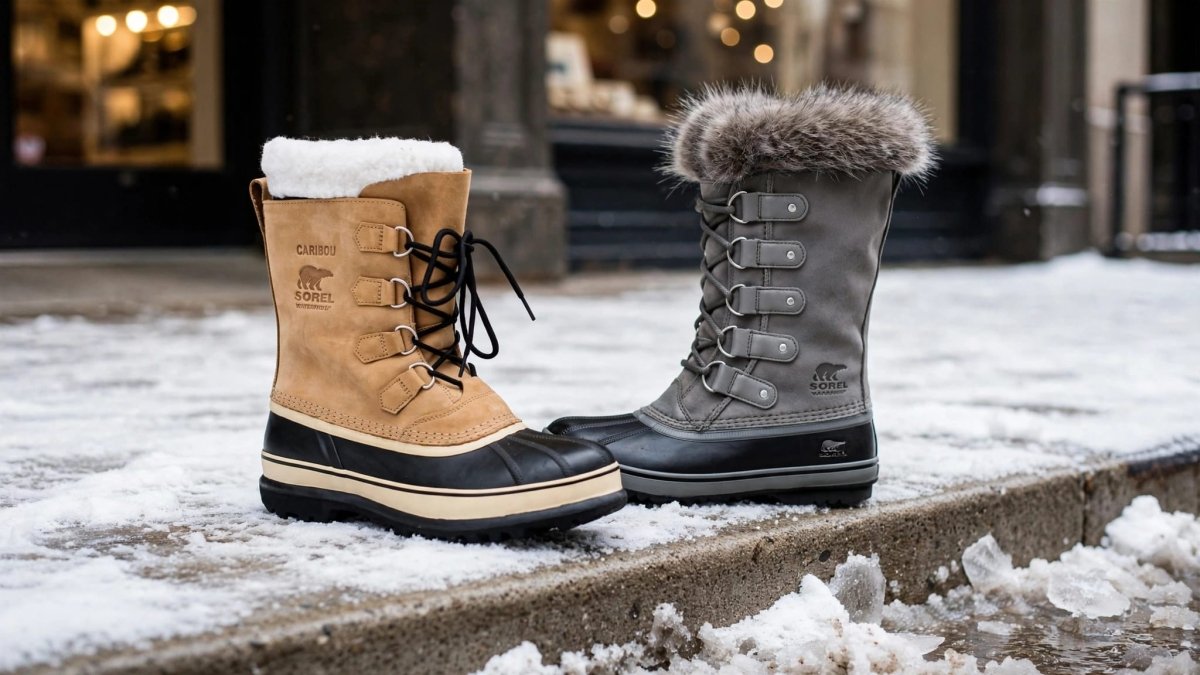
The hardest part of a snowy city walk is often the block after the plow passes. Packed snow, curbside slush, and wet entrances ask different things of your boots. Warm feet matter, but so do a secure fit and sensible expectations about traction.
Sorel winter boots offer two distinct choices in the Caribou and Joan of Arctic. The right pair depends less on the forecast than on the route you'll walk once you leave home.
What Sorel winter boots need to handle in the city
A city snow day rarely gives you one consistent surface. You might cross a drift at the curb, walk several cleared blocks, and step into a heated store without changing shoes. Look at the whole route before choosing the warmest-looking boot.
Keep snow out before trying to keep heat in
A tall shaft helps when snow piles above your ankles. A waterproof lower shell also protects the part of the boot most likely to meet puddles and slush. Both features matter if your walk includes uncleared sidewalks or deep curbside snow.
Warmth also depends on dry socks and room for your toes. A thick liner can't do its job well if the boot squeezes your foot or water enters over the top. If your usual route is mostly cleared pavement, consider how a substantial snow boot will feel indoors, too.
Treat grip as help, not a guarantee
Winter outsoles give you a better starting point on snow than smooth dress soles. Yet tread alone can't promise secure footing on glazed ice, especially over painted crossings or metal utility covers.
Check the sole's texture, then think about how and where you walk. Shorter steps and attention at curb cuts still matter. When ice coats your route, removable traction aids designed for ice may be more appropriate than relying on boot tread alone.
Caribou: the choice for deeper snow
The Caribou Women's Winter Boot is Sorel's snow-focused option. Its waterproof nubuck upper, seam-sealed construction, and rubber lower shell suit routes where clearing is inconsistent. Sorel lists the women's model for heavy snow; its US price was $250 in September 2026.

Protection around the foot and lower leg
The women's Caribou has a 9-inch shaft, a removable 9 mm recycled-felt inner boot, and a Sherpa-pile snow cuff. Beneath the foot, Sorel specifies a bonded felt frost plug. Its vulcanized rubber shell gives the lower boot a distinct barrier against wet snow.
Those parts make sense for a long walk through a neighborhood that hasn't been fully cleared. The tall construction may feel more substantial than you need for a quick trip along dry pavement, so weigh protection against the places you'll actually wear it.
A liner you can remove to dry
After a wet day, pull out the Caribou's inner boots and let them dry before the next outing. Sorel describes the felt liner as washable, but follow the care directions for your exact pair rather than washing the whole boot.
The removable design also offers a replacement path. Sorel listed women's Caribou inner-boot options at $40 and $45 in its September 2026 US collection. Confirm that a replacement matches your boot's model and size before ordering.
Joan of Arctic: a city-friendly snow boot
The Joan of Arctic Women's Waterproof Boot pairs a waterproof suede upper with a faux-fur cuff and molded rubber outsole. Sorel lists seam-sealed waterproof construction. Its US price was $240 in September 2026.

Winter protection with an everyday look
The suede-and-cuff combination works naturally with the clothes many people wear to work or out to dinner. It offers a different look from the Caribou's prominent rubber shell while retaining a waterproof construction for wet winter streets.
That makes Joan of Arctic appealing when your day moves between snowy sidewalks and indoor plans. If you expect repeated trips through deep, uncleared snow, compare its coverage with the Caribou before choosing on appearance alone. Tip Top Shoes has also shared outfit ideas for Sorel snow boots if you're deciding how a winter pair fits your usual wardrobe.
Check the exact liner details
Sorel's US Joan of Arctic product listing describes a removable liner. Product descriptions can differ by market or release, so check the specifications attached to the exact pair you're buying. Don't assume every Joan of Arctic listing has identical liner details.
A removable liner is useful if your boots get damp during the day. Take it out to dry separately, and give both the liner and shell time to air out before wearing them again.
Caribou vs. Joan of Arctic at a glance
Both are winter boots, but their designs answer slightly different shopping priorities.
| Feature | Women's Caribou | Women's Joan of Arctic |
|---|---|---|
| Best starting point | Deeper snow and longer outdoor exposure | Snowy errands with an everyday look |
| Upper and lower boot | Waterproof nubuck with a vulcanized rubber shell | Waterproof suede with a molded rubber outsole |
| Liner | Removable 9 mm recycled-felt inner boot | Removable liner; check the exact listing |
| US listed price, September 2026 | $250 | $240 |
Choose by the conditions you'll meet most often, not the worst storm you can picture. Tip Top Shoes has long featured the Caribou and Joan of Arctic as Sorel boots for snowy weather. For today's purchase, use the current product details and your own route as the deciding factors. Prices and availability can change.
Get the fit right before judging warmth
Even a well-insulated boot can leave feet cold if it's too tight. Before ordering, decide which socks you'll wear most often, then use those socks for your fit check. A thin everyday sock and a thick winter sock can make the same boot feel like two different sizes.
Give your toes room without losing your heel
Your toes should move freely when you're standing. Walk around and check whether your heel stays reasonably secure rather than sliding with every step. Then try a few stairs if you can. Stairs reveal heel movement and pressure across the top of the foot more clearly than standing still.
If the boot pinches with your intended socks, don't count on the liner flattening enough to fix the problem. On the other hand, excessive room can let your foot shift on uneven snow.
Build a sensible sock combination
A moisture-managing winter sock is often more useful than piling on multiple pairs. Smartwool and Darn Tough are familiar wool-blend options, and Tip Top Shoes carries winter sock brands alongside footwear. Choose a sock that fits smoothly inside the boot without bunching at the toes or tightening the instep.
Try the boots late in the day if your feet tend to swell. Fasten them as you would outdoors, then notice any rubbing at the heel or pressure near the ankle. Comfort during a short fitting is a better guide than a temperature number that doesn't account for your feet, socks, or activity.
Walk with confidence, especially when snow turns to ice
A snow boot's tread helps most when it can engage with the surface underfoot. Slush, compacted snow, wet tile, and clear ice behave differently. Even boots that feel secure on a snowy sidewalk may slip on a frozen puddle.
Watch the transitions
City walking puts slick surfaces close together. At a curb, snow can hide a puddle. Inside a lobby, melted snow can leave smooth flooring wet. Slow down at both transitions, and look for a clear place to plant each foot.
Neither the Caribou nor Joan of Arctic comes with a promise of slip-proof walking on ice. Sorel also notes that the laces on both product pages aren't waterproof. A waterproof boot can still admit water through the opening if you step into slush above the shell or leave the top loose.
Know when you need extra traction
If your regular walk includes untreated ice, consider a removable traction device made for those conditions. Check that it fits securely over your boots, and remove it when the maker's instructions call for removal on indoor floors or cleared surfaces.
When trying on any add-on, make sure it doesn't pull the boot out of shape or interfere with your stride. The goal is a stable step, not the feeling that something is shifting under the sole.
Match the boot to your actual route
Start with the least-cleared part of your day. Someone who walks several blocks after a snowfall may value the Caribou's taller shaft and rubber shell. Someone who crosses shorter stretches of slush before spending hours indoors may prefer the Joan of Arctic's suede upper and faux-fur cuff.
Also count how long you'll be outside. Waiting for a bus and walking across town place different demands on a boot. Neither product page gives you a verified temperature rating to settle that choice, and no single rating would replace a fit check.
If you visit Tip Top Shoes on West 72nd Street, bring the socks you'll wear in winter and describe your usual walk. A route with deep curbside snow calls for a different conversation than a mostly cleared commute. For online shopping, compare the exact product listing, your socks, and the retailer's current return terms before committing.
Keep your boots ready for the next storm
Drying matters as much as cleaning. After a slushy walk, remove the liners if your model allows it and let the boots air out away from direct heat. Brush off dried dirt gently before it builds up around seams and eyelets.
For suede or nubuck, follow Sorel's care guidance for the material rather than using a harsh household cleaner. Road salt deserves prompt attention, but aggressive scrubbing can damage the upper. Check the tread for packed debris before the next walk, and replace worn laces when they no longer hold the boot securely.
Key takeaways
- Pick the Caribou if deeper snow and longer outdoor stretches are routine.
- Consider the Joan of Arctic when you want waterproof winter construction with a suede-and-fur-cuff look.
- Try boots with your winter socks, and check toe room, heel hold, and walking comfort.
- Treat icy pavement separately from snow. Winter tread helps, but it doesn't make ice slip-proof.
Frequently asked questions
Are Sorel winter boots waterproof?
The women's Caribou and Joan of Arctic product pages both list waterproof, seam-sealed construction. That doesn't make every part of either boot waterproof: Sorel says their laces aren't. Water can also enter over the top, so match shaft height to the snow and slush on your route.
Which pair is better for deep snow?
Start with the Caribou. Sorel designates it for heavy snow, and its 9-inch shaft, felt inner boot, and vulcanized rubber shell suit prolonged exposure. Try it on before buying, since the best protection still has to fit your foot comfortably.
Can I wear these boots on icy sidewalks?
You can wear them, but don't treat either outsole as a guarantee against falls. Pay extra attention to clear ice, painted crossings, and wet indoor floors. If untreated ice is common on your route, look into a compatible removable traction aid.
The right pair for your winter walk
That difficult block after the plow passes is a useful test for your choice. The Caribou brings more snow-focused coverage; the Joan of Arctic pairs winter protection with a look that moves easily into everyday plans.
Choose the boot that fits your foot and your usual route. Then give ice the caution it deserves, whatever pair you're wearing.


