

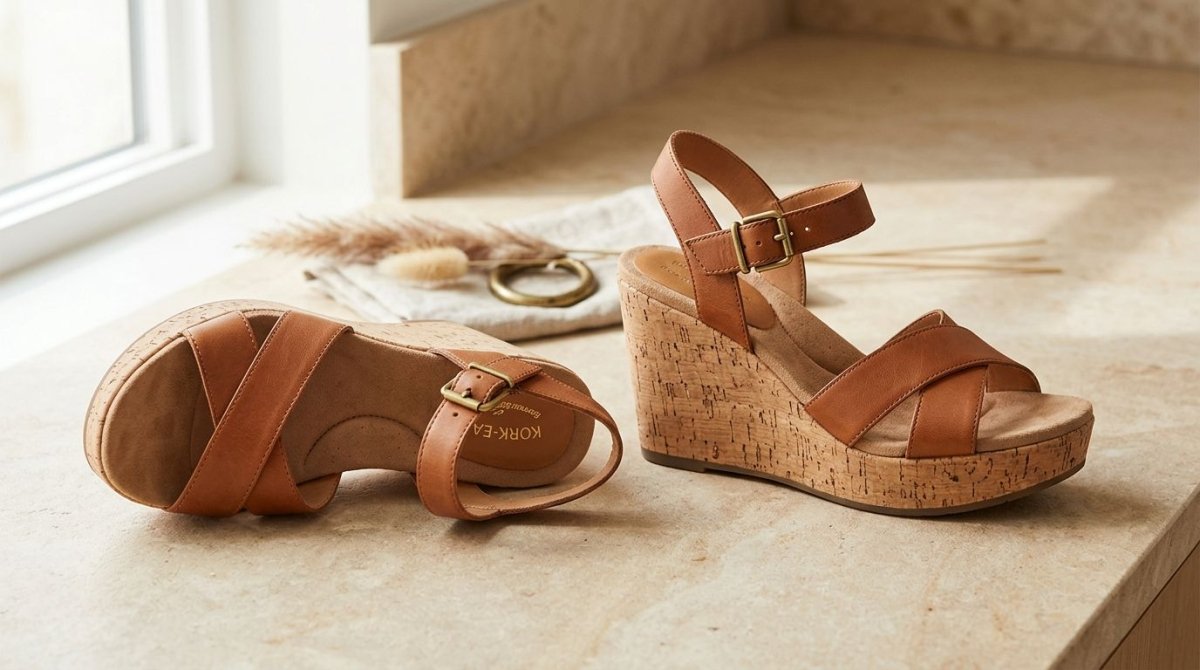
A cork-covered wedge can catch your eye before you notice what sits beneath your foot. When shopping for Kork-Ease wedges, focus on footbed fit, cushioning, and a secure upper rather than treating the cork appearance as a comfort guarantee.
The right combination should let you stand and walk without gripping your toes or sliding forward. Start by separating the visible cork finish from the footbed that supports your weight.
What Cork Means When Shopping for Kork-Ease Wedges
A cork exterior and a cork footbed are different
The footbed is the shaped surface beneath your foot. The wedge is the raised structure between that surface and the outsole. Although both can contain cork, their jobs differ.
Cork around the outside of a shoe can be a covering rather than the material supporting your foot. Likewise, a leather-covered footbed can hide the materials beneath it.
That distinction matters because a side view reveals height and appearance, but little about underfoot contour. Judge the surface your foot rests on separately from the wedge's exterior.
Cork is one part of the construction
Cork comes from cork oak bark and has a naturally lightweight, cellular structure. Footwear manufacturers can combine it with other materials, including latex, to create footbeds.
However, the finished shoe's feel also depends on its lining, cushioning layers, and shape. The word "cork" alone doesn't establish firmness, arch height, or flexibility.
We recommend treating material and design as separate considerations. A material you like still needs a shape that suits your foot.
Look for Contours That Match Your Foot
Arch support should land in the right place
A raised arch only helps when it meets your arch comfortably. Support that sits too far forward or backward can create a pressure point instead of distributing your weight.
Stand with your weight evenly balanced across both feet. You should feel broad contact beneath the arch rather than a hard lump pressing into one small area.
Also notice whether your foot rests naturally on the footbed. If you have to shift sideways to avoid pressure, the contour isn't a good match. Higher arch support isn't automatically better support.
Your heel and forefoot need enough room
Your heel should rest within the usable footbed, without hanging over the back or pressing against a raised edge. At the front, your toes need space to spread naturally.
Width matters just as much as length. If the ball of your foot extends beyond the supporting surface, a longer size may leave excess room without fixing the width.
Pay attention to any shaped ridge beneath the toes, too. It should meet your foot comfortably rather than force your toes into an awkward position.
A footbed can soften with wear, but break-in won't reliably fix an arch contour in the wrong place.
Separate Cushioning From Structural Support
Cushioning and support describe different qualities. Cushioning compresses beneath your weight; support comes largely from the shape and stability of the footbed.
A soft surface can feel inviting during a brief try-on. However, softness alone doesn't tell you whether your heel stays centered or your forefoot remains supported while walking.
Conversely, a firmer footbed isn't automatically uncomfortable. Broad, well-placed contact can feel comfortable without a plush surface. The important distinction is between even support and concentrated pressure.
Pressing the footbed with your thumb reveals some surface softness, but standing gives you more useful information. Walk, turn, and pause with your full weight on the shoes.
Also consider the lining against your skin. A smooth covering, an exposed seam, or a slippery surface can change how comfortable the same underlying shape feels.
Choose the balance that feels stable and comfortable under your weight. Don't assume that either maximum softness or maximum firmness is the goal.
Consider Wedge Shape and Strap Security Together
Platform height changes how the shoe feels
Heel height alone doesn't describe how steeply your foot sits. A raised forefoot platform reduces the height difference between the heel and the ball of the foot.
That difference affects your foot's angle, but it doesn't capture the entire walking experience. A thick platform also places your foot farther above the ground, so balance and sole shape matter.
Walk through a turn rather than judging the shoe while standing still. The wedge should feel predictable as your weight shifts, without tipping you sideways or forcing an exaggerated stride.
Straps should hold without squeezing
A comfortable footbed loses much of its value when your foot slides across it. The upper should hold your foot securely without pinching the toes or pressing hard across the instep.
If a style has adjustable straps, use them to improve contact rather than compensate for the wrong size. An overly tight strap can create friction even when the footbed feels good.
Watch for toe gripping as you walk. If you're curling your toes to keep the shoe attached, the overall fit needs attention.
Use a Consistent Try-On Routine
We recommend trying both shoes, because your feet may differ in size or shape. Fit the larger foot comfortably, then assess whether the other shoe remains secure.
Later-day try-ons can also be useful because feet often swell during daily activity. Wear the shoes as you intend to use them, including socks if they're part of your plan.
Follow the same sequence for each pair:
- Place your heel naturally on the footbed, then fasten any adjustable straps without overtightening them.
- Stand with your weight evenly distributed and notice pressure beneath the arch, heel, and forefoot.
- Walk several steps, turn, and stop to assess sliding, toe gripping, and balance.
- Remove the shoes and look for concentrated redness where an edge or strap pressed against your skin.
A brief try-on cannot predict every hour of wear. Still, it can reveal obvious fit problems.
Allow room for normal movement, but avoid choosing extra length simply because a strap feels tight. Footbed dimensions and upper volume are separate fitting issues.
Two Cork-Footbed Comparisons Worth Understanding
These Birkenstock styles illustrate different uses of cork footbeds. Their construction describes these products, not Kork-Ease wedges.
Birkenstock Arizona Soft Footbed
Our Arizona Soft Footbed in mink is priced at $140. This sandal combines a contoured cork-latex footbed with a suede footbed lining and two adjustable buckle straps.
Its open design gives you a useful way to assess foot placement. You can see whether your heel and toes sit within the footbed while adjusting the straps across the foot.
The Arizona is a flat sandal rather than a wedge. It offers a comparison for underfoot contour and adjustable fit, without reproducing the elevated position of a wedge.
Birkenstock Zermatt Shearling
Our Zermatt shearling slippers in mauve combine an anatomically shaped cork-latex footbed with a wool-felt upper and genuine shearling lining. They're made in Portugal.
Here, the lining adds warmth and changes the surface your foot touches. That makes the Zermatt a useful contrast to an open sandal, even though both use cork-latex footbeds.
The comparison highlights why material labels need context. A shearling-lined slipper and a suede-lined sandal can share a footbed material while offering different temperature, coverage, and fit characteristics.
Care for the Footbed Without Saturating It
Cork-footbed care starts with avoiding unnecessary soaking. Water can affect more than the cork itself, including adhesives, linings, and leather components.
Remove loose dirt gently before attempting deeper cleaning. For light surface marks, use minimal moisture and let the shoes dry naturally away from radiators or direct heat.
Don't apply cork sealer to every surface that looks like cork. Exposed cork, coated sidewalls, and footbed linings require different treatment. A treatment intended for bare cork doesn't belong automatically on suede or finished leather.
Also allow shoes to dry between wears rather than storing them while damp. As you handle them, watch for separating layers or damage where straps meet the shoe.
A split or loose attachment is a repair issue, not something normal break-in will resolve.
Key Takeaways
- Cork on a wedge's exterior doesn't establish what the footbed contains or how much support it provides.
- A suitable contour meets your arch comfortably and leaves your heel and forefoot fully supported.
- Cushioning, platform shape, and strap security work together, so assess the whole shoe while walking.
For Kork-Ease wedges, the most useful comfort test is your foot's position under load. Attractive materials matter, but they cannot compensate for pressure points or an unstable fit.
Frequently Asked Questions About Cork Footbeds
Do cork footbeds need to feel soft immediately?
No. Some cork-based footbeds feel firm, particularly when their design emphasizes contour rather than surface cushioning. Firmness can be comfortable when contact spreads evenly beneath your foot.
However, sharp pressure, numbness, or persistent rubbing aren't useful signs of break-in. Don't continue wearing a shoe through those symptoms. People with reduced sensation, circulation problems, or ongoing foot pain should seek guidance from a qualified healthcare professional.
Will a cork footbed mold to my feet?
Some cork-latex constructions adapt with wear. Birkenstock's contoured cork-latex footbed is an example, but that behavior isn't a promise for every cork-looking shoe.
The lining and overall construction affect how the footbed changes. Even an adaptable footbed needs suitable dimensions and comfortable initial placement.
Treat gradual adaptation as a refinement of a good fit. It won't reliably correct an undersized footbed, excessive sliding, or an arch shape that presses in the wrong place.
Choose Fit Before the Cork Finish
The cork you see is only one part of choosing comfortable Kork-Ease wedges. Prioritize well-placed support and judge how the complete shoe holds your foot while you walk.
Your heel should stay centered, your toes should relax, and the arch should feel supported without concentrated pressure. A pair that meets those conditions gives you a stronger starting point than appearance or softness alone.


